
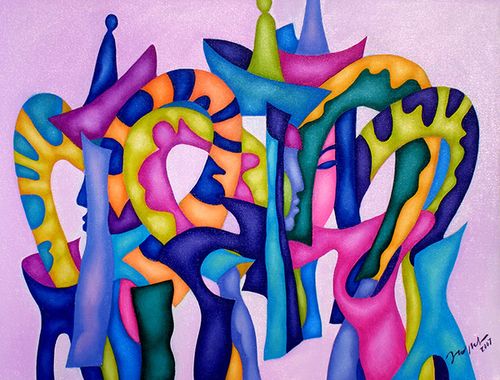
In the 2007 oil on canvas painting titled “Queens,” Enkhjargal Tsagaandari masterfully bridges the gap between traditional Mongolian heritage and contemporary abstraction. Measuring 40 x 60 cm, this work serves as a vibrant exploration of identity, grace, and the historical weight of Mongolian womanhood.
Artistic Composition and Style
Tsagaandari utilizes a figurative-abstract approach to depict a row of female figures. The composition is characterized by:
Rhythmic Flow: The “Queens” are arranged in a horizontal progression that suggests both stability and movement. Their silhouettes are stylized, emphasizing the iconic tall headdresses (khalkha) and voluminous robes traditional to Mongolian nobility.
Color Palette: True to her “Modern / Contemporary” style, the artist employs a rich, layered palette. Earthy tones are punctuated by bursts of symbolic color—deep ochres, royal blues, and crimson—reflecting the natural landscape of Mongolia and the vibrant textiles of its history.
Texture and Technique: The oil medium is applied with a visible, expressive hand. Tsagaandari’s background as a teacher and her experience in “Monumental Art” are evident in the confident, structural brushwork that gives the figures a sense of enduring presence.
Theme and Cultural Context
The painting is more than a portrait; it is an ode to the female spirit. Born in Ulaanbaatar in 1960, Tsagaandari grew up during a period of significant transition in Mongolia. This piece reflects her ability to synthesize the “Nature” and “Landscape” influences of her homeland with the human form.
The figures in “Queens” do not have hyper-detailed features; instead, they are rendered as archetypes. By stripping away individual facial details, the artist focuses on the collective dignity and the “Modern / Contemporary” interpretation of the feminine power that has anchored Mongolian society for centuries.
Historical Significance within the Artist’s Career
Created in 2007, during her tenure as a freelance artist, “Queens” represents a mature phase of Tsagaandari’s career. It follows decades of formal institutional work, including her time at the Military Institute and the Monumental Art atelier. This piece highlights her shift from the rigid requirements of state-affiliated art to a more fluid, expressive, and personal style that has been showcased globally from Ulaanbaatar to Vienna and China.
The painting stands as a testament to her role in the Union of Mongolian Artists, showcasing how she carries the weight of Mongolian tradition into the global contemporary art dialogue.