
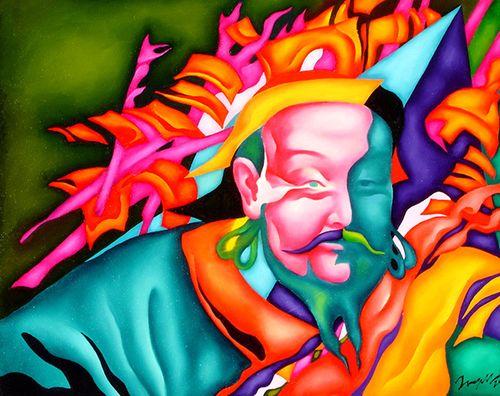
Chinggis Khan

Enkhjargal Tsagaandari , 2007 , Oil On Canvas

This evocative oil on canvas, measuring 45 x 60 cm, serves as a modern homage to the foundational figure of Mongolian identity. Painted in 2007 by Enkhjargal Tsagaandari, the work bridges the gap between historical reverence and contemporary abstraction, reflecting the artist’s deep roots in Ulaanbaatar and his evolution from a state-trained monumental artist to a versatile freelance visionary.

Visual Composition and Style

True to Tsagaandari’s background in Figurative and Abstract styles, the painting does not strive for the rigid realism of a traditional portrait. Instead, it captures the spirit and gravity of Chinggis Khan through a masterful application of oil pigments.

  • Color Palette: The artist utilizes a sophisticated blend of earthy ochres, deep ambers, and shadowy umbers. These tones evoke the rugged landscape of the Mongolian steppe, suggesting that the Great Khan is a figure literally born from the earth and the dust of history.

  • Atmosphere: There is a heavy, textured quality to the canvas. The brushwork likely balances the precision of his Military Institute training with the fluid, expressive freedom found in his later Contemporary and Nature works. The background likely feels atmospheric and expansive, mirroring the vastness of the Mongol Empire.

The Subject: Chinggis Khan

In this 2007 rendition, the Great Khan is depicted with a sense of monumental stillness. Drawing from his experience in the Monumental Art atelier, Tsagaandari gives the figure a weight that feels larger than the physical dimensions of the 45 x 60 cm frame.

  • The Gaze: The focal point of the work is the Great Khan’s expression—a blend of stoic determination and ancestral wisdom.

  • Symbolism: By integrating elements of Landscape and Nature, Tsagaandari subtly embeds the leader into the environment, reinforcing the Mongolian belief in the “Eternal Blue Sky” (Tenger) and the sacred connection between the leader and the land.

  • Enkhjargal Tsagaandari
  • Mongolian Style, Photorealism, Realism
  • Oil On Canvas
  • ENJ25/007
  • 45 x 60cm
  • Mongolian Art Gallery

Add Your Comment

Mongolian Art Gallery © 2025. All Rights Reserved
Privacy Policy / Terms of Use

This evocative oil on canvas, measuring 45 x 60 cm, serves as a modern homage to the foundational figure of Mongolian identity. Painted in 2007 by Enkhjargal Tsagaandari, the work bridges the gap between historical reverence and contemporary abstraction, reflecting the artist’s deep roots in Ulaanbaatar and his evolution from a state-trained monumental artist to a versatile freelance visionary.

Visual Composition and Style

True to Tsagaandari’s background in Figurative and Abstract styles, the painting does not strive for the rigid realism of a traditional portrait. Instead, it captures the spirit and gravity of Chinggis Khan through a masterful application of oil pigments.

  • Color Palette: The artist utilizes a sophisticated blend of earthy ochres, deep ambers, and shadowy umbers. These tones evoke the rugged landscape of the Mongolian steppe, suggesting that the Great Khan is a figure literally born from the earth and the dust of history.

  • Atmosphere: There is a heavy, textured quality to the canvas. The brushwork likely balances the precision of his Military Institute training with the fluid, expressive freedom found in his later Contemporary and Nature works. The background likely feels atmospheric and expansive, mirroring the vastness of the Mongol Empire.

The Subject: Chinggis Khan

In this 2007 rendition, the Great Khan is depicted with a sense of monumental stillness. Drawing from his experience in the Monumental Art atelier, Tsagaandari gives the figure a weight that feels larger than the physical dimensions of the 45 x 60 cm frame.

  • The Gaze: The focal point of the work is the Great Khan’s expression—a blend of stoic determination and ancestral wisdom.

  • Symbolism: By integrating elements of Landscape and Nature, Tsagaandari subtly embeds the leader into the environment, reinforcing the Mongolian belief in the “Eternal Blue Sky” (Tenger) and the sacred connection between the leader and the land.