
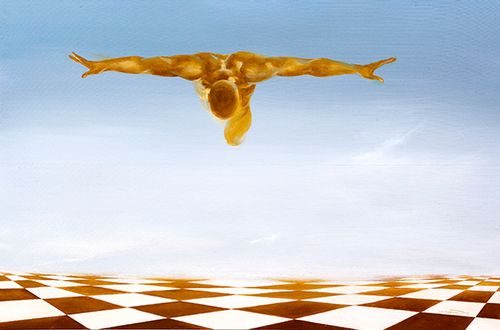
Theorem

Erdene Dash , 2007 , Oil On Canvas

Theorem is a profound masterwork by the late Mongolian artist Erdene Dash (1966–2009). Rendered in oil on a 90 x 135 cm canvas, the painting is a hallmark of Dash’s ability to synthesize rigorous Russian academic training with a deeply poetic, contemplative approach to the human form and the natural world.

Composition and Subject Matter

The painting presents a harmonious nude figure composition set against an expansive, atmospheric landscape. True to the title “Theorem,” the work explores the mathematical and spiritual proportions found in nature. Dash utilizes a sophisticated Realism technique to depict a central figure—likely female—whose anatomy is rendered with soft precision.

The figure is not merely “in” the landscape but serves as a structural extension of it. The curves of the body mirror the undulating horizon of the Mongolian steppe or the gentle slopes of distant hills, suggesting a “theorem” of existence where humanity and earth are governed by the same geometric and organic laws.

Artistic Style and Technique

Drawing from his education at the Surikov Art University and the Repin Academy of Arts, Dash employs a masterful use of light and shadow (chiaroscuro) to give the figure a tangible, three-dimensional presence.

  • Realism: Every brushstroke serves to define texture—from the velvet-like quality of skin to the ephemeral, hazy light of the background.

  • Landscape Integration: The background is not a mere backdrop but a character in itself. Dash uses a muted, earth-toned palette that emphasizes the vastness and solitude characteristic of his homeland’s topography.

  • Figurative Sophistication: The pose is deliberate and sculptural, avoiding the voyeuristic in favor of a dignified, almost architectural study of the body.

Symbolic Meaning

In the context of Dash’s body of work, Theorem represents the search for a fundamental truth. By stripping the subject of clothing and modern context, he focuses on the “purity of form.” The 2007 piece captures a moment of stillness, inviting the viewer to calculate the relationship between the finite human life and the infinite natural horizon.
  • Erdene Dash
  • Geometric, Sculpture
  • Oil On Canvas
  • ERE24/049
  • 90 x 135cm
  • Mongolian Art Gallery

Add Your Comment

Mongolian Art Gallery © 2025. All Rights Reserved
Privacy Policy / Terms of Use

Theorem is a profound masterwork by the late Mongolian artist Erdene Dash (1966–2009). Rendered in oil on a 90 x 135 cm canvas, the painting is a hallmark of Dash’s ability to synthesize rigorous Russian academic training with a deeply poetic, contemplative approach to the human form and the natural world.

Composition and Subject Matter

The painting presents a harmonious nude figure composition set against an expansive, atmospheric landscape. True to the title “Theorem,” the work explores the mathematical and spiritual proportions found in nature. Dash utilizes a sophisticated Realism technique to depict a central figure—likely female—whose anatomy is rendered with soft precision.

The figure is not merely “in” the landscape but serves as a structural extension of it. The curves of the body mirror the undulating horizon of the Mongolian steppe or the gentle slopes of distant hills, suggesting a “theorem” of existence where humanity and earth are governed by the same geometric and organic laws.

Artistic Style and Technique

Drawing from his education at the Surikov Art University and the Repin Academy of Arts, Dash employs a masterful use of light and shadow (chiaroscuro) to give the figure a tangible, three-dimensional presence.

  • Realism: Every brushstroke serves to define texture—from the velvet-like quality of skin to the ephemeral, hazy light of the background.

  • Landscape Integration: The background is not a mere backdrop but a character in itself. Dash uses a muted, earth-toned palette that emphasizes the vastness and solitude characteristic of his homeland’s topography.

  • Figurative Sophistication: The pose is deliberate and sculptural, avoiding the voyeuristic in favor of a dignified, almost architectural study of the body.

Symbolic Meaning

In the context of Dash’s body of work, Theorem represents the search for a fundamental truth. By stripping the subject of clothing and modern context, he focuses on the “purity of form.” The 2007 piece captures a moment of stillness, inviting the viewer to calculate the relationship between the finite human life and the infinite natural horizon.