

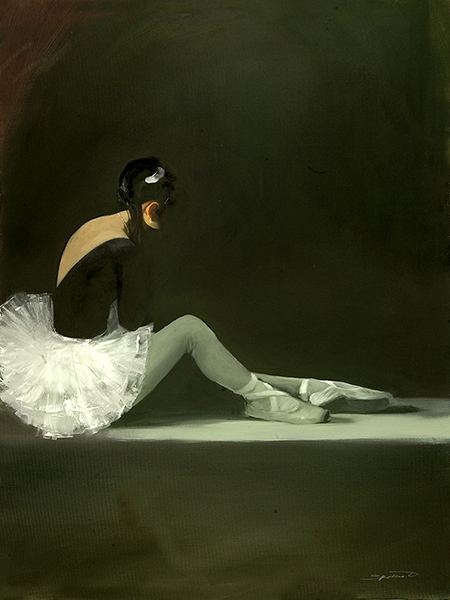
Ballerino is a masterful synthesis of academic rigor and naturalistic poetry. Painted just two years before the artist’s passing, this work exemplifies Erdene Dash’s ability to merge the disciplined anatomical precision of his Russian training (Repin Academy) with the expansive, soul-stirring landscapes of his Mongolian heritage.
The Figure: Form and Poise
At the heart of the composition is a nude male figure, rendered with the exacting detail of classical realism. The subject, a male dancer (ballerino), is captured in a moment of profound stillness that suggests latent kinetic energy.
Anatomy: Every muscle group—from the definition of the deltoids to the tension in the calves—is articulated with a deep understanding of human physiology. The skin reflects a subtle interplay of light and shadow (chiaroscuro), giving the body a three-dimensional, sculptural presence.
Pose: Unlike a traditional stage performance, the figure is placed in an organic environment. His posture is one of controlled grace, perhaps mid-stretch or in a contemplative stance that mimics the peaks and valleys of the surrounding terrain.
Landscape and Atmosphere
Dash deviates from traditional studio portraiture by placing the nude figure within a vast, nature-inspired setting.
The Horizon: The landscape reflects the characteristic “Great Wide Open” of Mongolia. The background features rolling hills or distant mountains under a sky that feels infinite, utilizing a palette of earthy ochres, muted greens, and cool atmospheric blues.
The Element of Contrast: There is a deliberate juxtaposition between the “soft” vulnerability of the human skin and the “hard” resilience of the wild earth. This creates a narrative of man as an extension of nature—both are beautiful, structured, and inherently wild.
Technique and Style
The painting serves as a testament to the Realism Art Techniques Dash perfected in Moscow and Saint Petersburg.
Brushwork: While the figure is rendered with smooth, almost invisible transitions to emphasize the suppleness of flesh, the landscape background often employs broader, more textural strokes to convey the ruggedness of the earth.
Lighting: The light source feels naturalistic, as if coming from a low-hanging sun on the steppe. This light catches the contours of the ballerino’s body, grounding him firmly within the physical space of the canvas.
Symbolism
In Ballerino, the “dance” is not a performance for an audience, but a silent dialogue between the individual and the universe. The 70 x 93 cm format provides a horizontal expanse that emphasizes the breadth of the land, suggesting that while the human form is a pinnacle of biological art, it is ultimately part of the larger, timeless landscape.
