
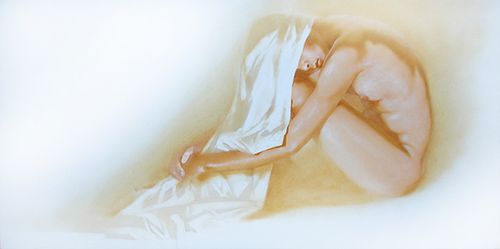
Nostalgia

Erdene Dash , 2007 , Oil On Canvas

Nostalgia is a masterful synthesis of classical Russian academic training and the profound, spiritual connection to the Mongolian landscape. Painted in 2007, just two years before the artist’s passing, the work utilizes a wide, panoramic format (46 x 93 cm) to evoke a sense of immense space and temporal distance. The composition is a sophisticated exercise in Realism, blending a detailed nude figure with an atmospheric, nature-inspired backdrop.

The Landscape

The setting reflects the vastness of the Mongolian steppe, rendered with the atmospheric precision Dash honed at the Repin Academy of Arts. The horizon line is placed thoughtfully to emphasize the scale of the sky or the rolling earth, creating a vacuum of silence that justifies the painting’s title. The earth is depicted in muted, earthy tones—ochres, burnt umbers, and soft sages—which suggest a season of transition, perhaps late autumn or a fading twilight.

The Nude Figure

Central to the work is a nude figure, executed with the rigorous anatomical accuracy characteristic of the Surikov and Repin traditions. The figure is not merely a subject but an extension of the terrain. The skin tones are rendered with a delicate interplay of warm highlights and cool, translucent shadows, catching a soft, directional light that feels like the “golden hour.”

The pose is one of introspection and vulnerability. The figure’s integration into the landscape suggests a return to origins—a literal and metaphorical “stripping away” of the modern world to reconnect with the primal essence of nature.

Style and Technique

  • Academic Realism: The brushwork is disciplined yet expressive. Dash employs fine glazes to achieve the luminosity of human skin, contrasted against broader, more textural strokes for the grass and distant hills.

  • Atmospheric Perspective: There is a palpable sense of air and depth. The background recedes into a soft-focus haze, pulling the viewer’s eye toward the clarity of the figure in the foreground.

  • Thematic Depth: The “Nostalgia” referenced is not merely a memory of a place, but a longing for a state of being. The wide-angle perspective creates a “cinematic” stillness, making the viewer feel like a quiet observer of a private, sacred moment between humanity and the earth.

The Mongolian-Russian Fusion

While the technique is rooted in the 19th-century Russian Realist tradition, the soul of the painting is quintessentially Mongolian. It captures the solitude and nomadic spirit of Ulaanbaatar’s heritage, where the body is seen as a small, fleeting element within an eternal, unchanging landscape. The result is a poignant, quiet masterpiece that balances the weight of physical presence with the lightness of memory.

  • Erdene Dash
  • Calligraphy, Nude
  • Oil On Canvas
  • ERE24/042
  • 46 x 93cm
  • Mongolian Art Gallery

Add Your Comment

Mongolian Art Gallery © 2025. All Rights Reserved
Privacy Policy / Terms of Use

Nostalgia is a masterful synthesis of classical Russian academic training and the profound, spiritual connection to the Mongolian landscape. Painted in 2007, just two years before the artist’s passing, the work utilizes a wide, panoramic format (46 x 93 cm) to evoke a sense of immense space and temporal distance. The composition is a sophisticated exercise in Realism, blending a detailed nude figure with an atmospheric, nature-inspired backdrop.

The Landscape

The setting reflects the vastness of the Mongolian steppe, rendered with the atmospheric precision Dash honed at the Repin Academy of Arts. The horizon line is placed thoughtfully to emphasize the scale of the sky or the rolling earth, creating a vacuum of silence that justifies the painting’s title. The earth is depicted in muted, earthy tones—ochres, burnt umbers, and soft sages—which suggest a season of transition, perhaps late autumn or a fading twilight.

The Nude Figure

Central to the work is a nude figure, executed with the rigorous anatomical accuracy characteristic of the Surikov and Repin traditions. The figure is not merely a subject but an extension of the terrain. The skin tones are rendered with a delicate interplay of warm highlights and cool, translucent shadows, catching a soft, directional light that feels like the “golden hour.”

The pose is one of introspection and vulnerability. The figure’s integration into the landscape suggests a return to origins—a literal and metaphorical “stripping away” of the modern world to reconnect with the primal essence of nature.

Style and Technique

  • Academic Realism: The brushwork is disciplined yet expressive. Dash employs fine glazes to achieve the luminosity of human skin, contrasted against broader, more textural strokes for the grass and distant hills.

  • Atmospheric Perspective: There is a palpable sense of air and depth. The background recedes into a soft-focus haze, pulling the viewer’s eye toward the clarity of the figure in the foreground.

  • Thematic Depth: The “Nostalgia” referenced is not merely a memory of a place, but a longing for a state of being. The wide-angle perspective creates a “cinematic” stillness, making the viewer feel like a quiet observer of a private, sacred moment between humanity and the earth.

The Mongolian-Russian Fusion

While the technique is rooted in the 19th-century Russian Realist tradition, the soul of the painting is quintessentially Mongolian. It captures the solitude and nomadic spirit of Ulaanbaatar’s heritage, where the body is seen as a small, fleeting element within an eternal, unchanging landscape. The result is a poignant, quiet masterpiece that balances the weight of physical presence with the lightness of memory.