

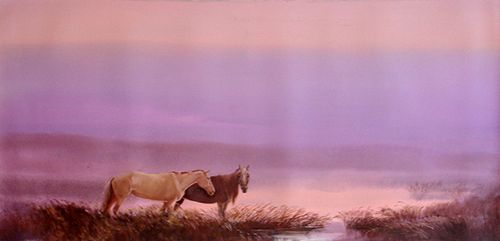
Steppe is a masterful oil-on-canvas composition that exemplifies Erdene Dash’s unique ability to fuse the rigors of Russian academic realism with the soul-stirring expansiveness of his Mongolian heritage. Measuring 46 x 92 cm, the painting utilizes a wide, panoramic format to emphasize the infinite horizon of the Central Asian grasslands.
Composition and Figure
At the heart of the work is a nude figure composition that is integrated seamlessly into the natural environment. Eschewing the traditional studio backdrop, Dash places the human form directly onto the earth. The figure is typically depicted in a reclining or restful pose, mirroring the undulating curves of the hills. The anatomical precision—a hallmark of Dash’s training at the Repin Academy of Arts—is evident in the subtle play of musculature and the soft, realistic rendering of skin tones.
The figure does not appear as an intruder upon the land; rather, through Dash’s figurative realism, the body becomes an extension of the landscape itself—a “human topography” that echoes the ridges and valleys of the steppe.
Landscape and Atmosphere
The “Steppe” of the title is rendered with profound atmospheric depth. The artist employs a palette of:
Earthy Ochres and Raw Siennas: Representing the sun-scorched grasses of the Mongolian plateau.
Muted Greens and Umbers: Defining the subtle shifts in vegetation and soil.
Soft Cerulean and Grays: Occupying the vast upper register of the canvas to depict a sky that feels both heavy and infinite.
The light is soft and diffused, suggesting the “golden hour” of a late afternoon. This lighting casts long, gentle shadows that give the painting a sense of stillness and timelessness.
Technique and Style
The technical execution reflects a high level of Realism. Dash uses controlled, fluid brushwork to transition between the textured foreground of the grass and the smooth, porcelain-like finish of the figure’s skin. The wide 1:2 aspect ratio of the canvas forces the viewer’s eye to sweep across the work, mimicking the way one would view a physical horizon.
Thematic Essence
The painting serves as a poetic meditation on the interconnectedness of nature and humanity. By stripping the figure of clothing and artifice and placing it in the raw, unadorned beauty of the Mongolian wilderness, Dash highlights a primal, spiritual bond. It is a work of quiet power, balancing the vulnerability of the nude form against the enduring, rugged majesty of the earth.