
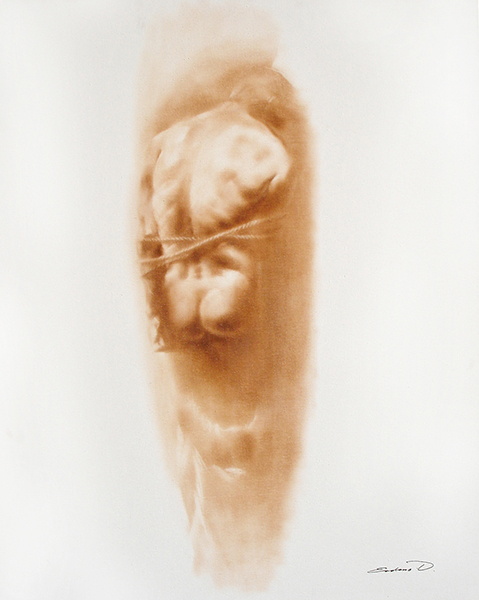
Freedom

Erdene Dash , 2007 , Oil On Canvas

Freedom is a masterclass in Academic Realism, blending the rigorous technical training of the Repin Academy with the expansive, spiritual atmosphere of the Mongolian landscape. The painting features a central nude figure set against a vast, open horizon, serving as a profound exploration of the relationship between the human form and the natural world.

Composition and Figure

The composition is dominated by a nude figure, rendered with the anatomical precision characteristic of Dash’s Russian training. The figure is positioned in a way that suggests both vulnerability and immense strength. Rather than being a study of voyeurism, the nudity acts as a symbol of purity and liberation—stripping away societal layers to return the human soul to its primal state.

The skin tones are handled with a sophisticated palette of warm ochres, soft pinks, and cool shadows, capturing the play of natural light across the musculature and curves. The posture is one of rhythmic grace, perhaps caught in a moment of movement or deep contemplation, echoing the contours of the earth beneath.

Landscape and Atmosphere

The background is an expansive landscape that evokes the high-altitude clarity and infinite horizons of Mongolia.

  • The Sky: Taking up a significant portion of the canvas, the sky is rendered with subtle gradients, suggesting the “Eternal Blue Sky” or the soft, hazy light of a late afternoon.

  • The Earth: The terrain is often depicted with earthy tones—siennas, muted greens, and ambers—providing a textured, grounded contrast to the smooth luminosity of the human skin.

  • Depth: Dash utilizes aerial perspective to create a sense of infinite distance, making the figure appear as a singular, vital spark within an overwhelming expanse of nature.

Style and Technique

The painting showcases a seamless fusion of Figurative Realism and Nature-Inspired Art.

  • Brushwork: While the figure is rendered with smooth, meticulous transitions, the surrounding environment often features more expressive, tactile brushstrokes, highlighting the raw energy of the wild.

  • Chiaroscuro: Dash employs a gentle use of light and shadow to give the figure three-dimensional volume, ensuring it stands out as a focal point without feeling disconnected from the environment.

Symbolism and Mood

The title, Freedom, is realized through the absence of boundaries. There are no buildings, no clothes, and no markers of time. The painting captures a moment of existential harmony, where the “freedom” described is the ability of the individual to exist fully and authentically within the cosmos. It reflects Erdene Dash’s unique ability to bridge the gap between classical European techniques and the nomadic, spiritual heritage of his birthplace, Ulaanbaatar.
  • Erdene Dash
  • Modern/Minimalist, Nude
  • Oil On Canvas
  • ERE24/008
  • 90 x 72cm
  • Mongolian Art Gallery

Add Your Comment

Mongolian Art Gallery © 2025. All Rights Reserved
Privacy Policy / Terms of Use

Freedom is a masterclass in Academic Realism, blending the rigorous technical training of the Repin Academy with the expansive, spiritual atmosphere of the Mongolian landscape. The painting features a central nude figure set against a vast, open horizon, serving as a profound exploration of the relationship between the human form and the natural world.

Composition and Figure

The composition is dominated by a nude figure, rendered with the anatomical precision characteristic of Dash’s Russian training. The figure is positioned in a way that suggests both vulnerability and immense strength. Rather than being a study of voyeurism, the nudity acts as a symbol of purity and liberation—stripping away societal layers to return the human soul to its primal state.

The skin tones are handled with a sophisticated palette of warm ochres, soft pinks, and cool shadows, capturing the play of natural light across the musculature and curves. The posture is one of rhythmic grace, perhaps caught in a moment of movement or deep contemplation, echoing the contours of the earth beneath.

Landscape and Atmosphere

The background is an expansive landscape that evokes the high-altitude clarity and infinite horizons of Mongolia.

  • The Sky: Taking up a significant portion of the canvas, the sky is rendered with subtle gradients, suggesting the “Eternal Blue Sky” or the soft, hazy light of a late afternoon.

  • The Earth: The terrain is often depicted with earthy tones—siennas, muted greens, and ambers—providing a textured, grounded contrast to the smooth luminosity of the human skin.

  • Depth: Dash utilizes aerial perspective to create a sense of infinite distance, making the figure appear as a singular, vital spark within an overwhelming expanse of nature.

Style and Technique

The painting showcases a seamless fusion of Figurative Realism and Nature-Inspired Art.

  • Brushwork: While the figure is rendered with smooth, meticulous transitions, the surrounding environment often features more expressive, tactile brushstrokes, highlighting the raw energy of the wild.

  • Chiaroscuro: Dash employs a gentle use of light and shadow to give the figure three-dimensional volume, ensuring it stands out as a focal point without feeling disconnected from the environment.

Symbolism and Mood

The title, Freedom, is realized through the absence of boundaries. There are no buildings, no clothes, and no markers of time. The painting captures a moment of existential harmony, where the “freedom” described is the ability of the individual to exist fully and authentically within the cosmos. It reflects Erdene Dash’s unique ability to bridge the gap between classical European techniques and the nomadic, spiritual heritage of his birthplace, Ulaanbaatar.