

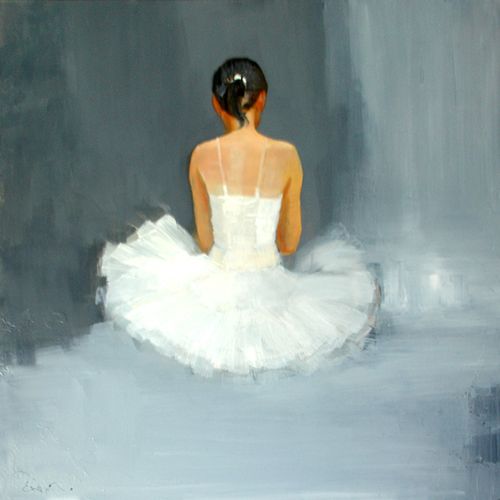
Ballerina 1 is a compelling fusion of academic realism and organic naturalism. Set within a perfectly square 46 x 46 cm frame, the painting offers an intimate, focused study of the human form. Rather than the traditional stage or studio setting, Dash places the figure in a context inspired by the natural world, bridging the gap between a landscape study and a nude figure composition.
The subject is depicted with the rigorous anatomical precision characteristic of Dash’s training at the Repin Academy of Arts. The ballerina’s physique is rendered with lean, muscular clarity, emphasizing the strength and discipline inherent to her craft. Her pose is a masterclass in tension and grace—perhaps mid-stretch or in a moment of quiet repose—where the curvature of the spine and the extension of the limbs create a fluid, rhythmic line that guides the viewer’s eye across the canvas.
Technique and Style
Drawing from the traditions of Russian Realism, Dash utilizes oil paints to create a rich, tactile surface. The brushwork is sophisticated, alternating between smooth, luminous skin tones and more textured, expressive applications in the background elements.
Realism: The artist captures the subtle play of light and shadow (chiaroscuro) across the muscles, giving the figure a three-dimensional, sculptural quality.
Nature Integration: True to the “Nature-Inspired” tag, the backdrop avoids domestic clutter. Instead, it utilizes an earthy, muted palette that suggests an outdoor environment or a landscape seen through a dreamlike, atmospheric lens.
Color Palette: The work likely favors a sophisticated harmony of flesh tones, deep umbers, and soft greens or ochres, reflecting Dash’s Mongolian heritage and his affinity for the natural world.
Atmosphere and Interpretation
There is a profound sense of solitude and “quiet power” in this piece. By stripping away the tulle and satin of a typical ballerina portrait and focusing on the nude figure, Dash highlights the raw, elemental beauty of the dancer. The painting serves as a bridge between two worlds: the strict, disciplined education of the Saint Petersburg academies and the expansive, spiritual connection to nature often found in Mongolian contemporary art.