
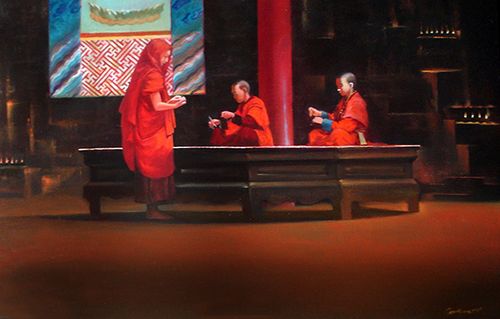
In The Gandan

Erdene Dash , 2006 , Oil On Canvas

The painting presents a profound juxtaposition between the vulnerability of the human form and the timeless, spiritual weight of the Gandantegchinlen Monastery in Ulaanbaatar. Erdene Dash utilizes a masterly application of Academic Realism—a nod to his rigorous training at the Repin Academy—to create a scene that feels both grounded in physical reality and elevated by a quiet, contemplative atmosphere.

The Central Figure

Occupying a significant portion of the foreground, a nude figure is depicted with anatomical precision. The skin tones are rendered through a complex layering of oils, capturing the way natural light strikes the body to create a soft, luminous glow. The pose is not provocative but rather suggests a state of meditation or raw existence, harmonizing the “nature” of the human body with the “nature” of the surroundings.

The Setting: Gandan Monastery

The background captures the iconic architectural elements of the Gandan complex. Through the use of atmospheric perspective, the ornate rooftops and sturdy pillars of the temples are rendered with slightly softer edges than the figure, providing a sense of depth and scale. The palette consists of:

  • Earth Tones: Deep ochres and burnt siennas reflecting the monastery walls and the Mongolian earth.

  • Sacred Accents: Hints of traditional reds and weathered golds on the temple eaves.

  • Natural Light: A clear, high-altitude light typical of Ulaanbaatar, which casts long, soft shadows and defines the textures of both the canvas and the architecture.

Composition and Technique

The 40 x 60 cm landscape orientation creates a wide, cinematic view. Dash employs a sophisticated balance of “lost and found” edges; while the figure is defined by sharp, confident brushwork, the edges of the monastery structures occasionally bleed into the sky or the shadows, suggesting the passage of time and the ephemeral nature of life compared to the permanence of the spiritual site.

  • Erdene Dash
  • Figurative, Landscape
  • Oil On Canvas
  • ERE24/002
  • 40 x 60cm
  • Mongolian Art Gallery

Add Your Comment

Mongolian Art Gallery © 2025. All Rights Reserved
Privacy Policy / Terms of Use

The painting presents a profound juxtaposition between the vulnerability of the human form and the timeless, spiritual weight of the Gandantegchinlen Monastery in Ulaanbaatar. Erdene Dash utilizes a masterly application of Academic Realism—a nod to his rigorous training at the Repin Academy—to create a scene that feels both grounded in physical reality and elevated by a quiet, contemplative atmosphere.

The Central Figure

Occupying a significant portion of the foreground, a nude figure is depicted with anatomical precision. The skin tones are rendered through a complex layering of oils, capturing the way natural light strikes the body to create a soft, luminous glow. The pose is not provocative but rather suggests a state of meditation or raw existence, harmonizing the “nature” of the human body with the “nature” of the surroundings.

The Setting: Gandan Monastery

The background captures the iconic architectural elements of the Gandan complex. Through the use of atmospheric perspective, the ornate rooftops and sturdy pillars of the temples are rendered with slightly softer edges than the figure, providing a sense of depth and scale. The palette consists of:

  • Earth Tones: Deep ochres and burnt siennas reflecting the monastery walls and the Mongolian earth.

  • Sacred Accents: Hints of traditional reds and weathered golds on the temple eaves.

  • Natural Light: A clear, high-altitude light typical of Ulaanbaatar, which casts long, soft shadows and defines the textures of both the canvas and the architecture.

Composition and Technique

The 40 x 60 cm landscape orientation creates a wide, cinematic view. Dash employs a sophisticated balance of “lost and found” edges; while the figure is defined by sharp, confident brushwork, the edges of the monastery structures occasionally bleed into the sky or the shadows, suggesting the passage of time and the ephemeral nature of life compared to the permanence of the spiritual site.