
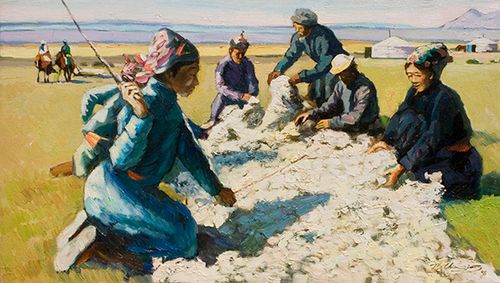
Agriculture is a panoramic masterwork that blends the precision of Photorealism with the soulful depth of Mongolian Realism. The horizontal orientation (59 x 105 cm) serves to emphasize the vastness of the Mongolian steppe, creating a cinematic window into a rural lifestyle that is both timeless and demanding.
The Figures (Figurative Art & Portraiture)
At the heart of the composition are the human subjects, rendered with such anatomical and textural accuracy that they lean into the realm of Portraiture. Tulgabaatar captures the weathered skin, squinted eyes, and sturdy posture of Mongolian farmers or herders. Their clothing—likely traditional deels modified for labor—shows the tactile quality of heavy fabric, dusted with the earth they cultivate. Their expressions are not of hardship, but of quiet, stoic dignity, reflecting a profound connection to the land.
The Landscape and Nature
The backdrop is a sweeping Landscape that showcases the artist’s technical prowess in capturing light. The vast Mongolian sky dominates the upper third of the canvas, likely depicted during the “golden hour” to cast long, soft shadows across the tilled earth. The soil itself is a focal point of Photorealistic detail; one can almost sense the moisture in the overturned clumps of dirt and the sparse, resilient vegetation clinging to the periphery of the field.
Style and Technique
Light and Shadow: Tulgabaatar uses a naturalistic light source to create three-dimensional volume in the figures. The interplay of light on the folds of their clothing and the rugged terrain adds a sense of “hyper-presence.”
Color Palette: The work utilizes a grounded, earthy palette—ochres, deep browns, dusty greens, and the brilliant, pale blue of the high-altitude Mongolian sky. These tones harmonize to evoke a sense of peace and environmental belonging.
Atmosphere: Despite the “Still Life” quality often found in Photorealism, there is an implied movement here—the rustle of wind through the grass or the heavy breath of the workers—making the scene feel lived-in rather than staged.
Cultural Significance
Created in 2008, when Tulgabaatar was in his early twenties, Agriculture represents a bridge between the academic traditions of Mongolian art and a modern, globalized technical standard. By focusing on agriculture—a sector often overshadowed by nomadic herding in Mongolian iconography—the artist highlights a vital, grounded aspect of national identity.
The painting stands as a tribute to the labor that sustains the nation, elevated by a style that demands the viewer notice every grain of sand and every line of experience on the subjects’ faces.