Portrait

Chinggis Tulgabaatar , 2008 , Oil On Canvas

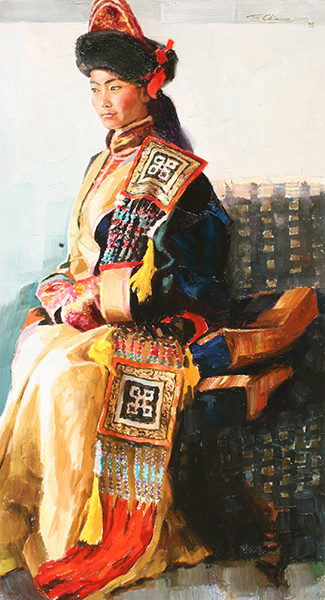
“Portrait” is a striking example of contemporary Mongolian photorealism, measuring 105 x 53.5 cm. The vertical orientation and narrow dimensions emphasize the singular, focused presence of the subject. Created during a period when Tulgabaatar was establishing himself as a master of figurative art, the work serves as a bridge between traditional Mongolian identity and modern realist techniques.

Subject and Composition

The painting features a central figure rendered with meticulous detail. True to the artist’s background in Photorealism and Realism, the subject is depicted with anatomical precision, capturing subtle nuances in skin texture, the moisture of the eyes, and the organic flow of hair. The composition is intimate, drawing the viewer into a direct, quiet dialogue with the subject.

While titled simply “Portrait,” the work carries the weight of the artist’s heritage. The figure often embodies a sense of quiet strength and stoicism, characteristic of Tulgabaatar’s subjects, who frequently appear as though caught in a moment of deep reflection.

Style and Technique

  • Photorealistic Precision: Tulgabaatar employs thin, controlled layers of oil paint to eliminate visible brushstrokes, achieving a finish that mimics the clarity of a high-resolution photograph.

  • Light and Shadow: The artist uses a sophisticated “Chiaroscuro” effect, where light falls softly across one side of the face, leaving the other in gentle shadow. This technique creates a three-dimensional depth that makes the figure appear to emerge from the canvas.

  • Color Palette: The palette is dominated by earthy, natural tones—ochres, deep browns, and warm flesh tints. These colors reflect the Nature and Landscape influences associated with the artist, grounding the human subject in the natural world of Mongolia.

Integration of Nature and Figure

A hallmark of Tulgabaatar’s 2008 works is the subtle integration of the human form with natural elements. In this portrait, the background is often a muted, atmospheric space that suggests a vast Mongolian landscape without being literal. This “Figurative Art” approach ensures that the focus remains on the human spirit, yet suggests that the individual is inseparable from their environment.

Atmosphere and Meaning

The 2008 “Portrait” is characterized by a profound stillness. It does not capture an action, but rather a state of being. By stripping away ornamental distractions, Tulgabaatar forces the viewer to confront the raw humanity of the subject. The work reflects the artist’s birthplace, Ulaanbaatar, by blending the rugged, timeless endurance of the Mongolian people with the sophisticated, technical polish of global contemporary art.
  • Chinggis Tulgabaatar
  • Portrait, Realism
  • Oil On Canvas
  • CHI72/057
  • 105 x 53.5cm
  • Mongolian Art Gallery

Add Your Comment

Mongolian Art Gallery © 2025. All Rights Reserved
Privacy Policy / Terms of Use

“Portrait” is a striking example of contemporary Mongolian photorealism, measuring 105 x 53.5 cm. The vertical orientation and narrow dimensions emphasize the singular, focused presence of the subject. Created during a period when Tulgabaatar was establishing himself as a master of figurative art, the work serves as a bridge between traditional Mongolian identity and modern realist techniques.

Subject and Composition

The painting features a central figure rendered with meticulous detail. True to the artist’s background in Photorealism and Realism, the subject is depicted with anatomical precision, capturing subtle nuances in skin texture, the moisture of the eyes, and the organic flow of hair. The composition is intimate, drawing the viewer into a direct, quiet dialogue with the subject.

While titled simply “Portrait,” the work carries the weight of the artist’s heritage. The figure often embodies a sense of quiet strength and stoicism, characteristic of Tulgabaatar’s subjects, who frequently appear as though caught in a moment of deep reflection.

Style and Technique

  • Photorealistic Precision: Tulgabaatar employs thin, controlled layers of oil paint to eliminate visible brushstrokes, achieving a finish that mimics the clarity of a high-resolution photograph.

  • Light and Shadow: The artist uses a sophisticated “Chiaroscuro” effect, where light falls softly across one side of the face, leaving the other in gentle shadow. This technique creates a three-dimensional depth that makes the figure appear to emerge from the canvas.

  • Color Palette: The palette is dominated by earthy, natural tones—ochres, deep browns, and warm flesh tints. These colors reflect the Nature and Landscape influences associated with the artist, grounding the human subject in the natural world of Mongolia.

Integration of Nature and Figure

A hallmark of Tulgabaatar’s 2008 works is the subtle integration of the human form with natural elements. In this portrait, the background is often a muted, atmospheric space that suggests a vast Mongolian landscape without being literal. This “Figurative Art” approach ensures that the focus remains on the human spirit, yet suggests that the individual is inseparable from their environment.

Atmosphere and Meaning

The 2008 “Portrait” is characterized by a profound stillness. It does not capture an action, but rather a state of being. By stripping away ornamental distractions, Tulgabaatar forces the viewer to confront the raw humanity of the subject. The work reflects the artist’s birthplace, Ulaanbaatar, by blending the rugged, timeless endurance of the Mongolian people with the sophisticated, technical polish of global contemporary art.