
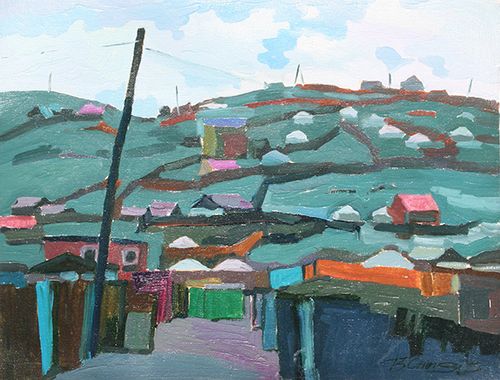
Ger District 4

Chinggis Tulgabaatar , 2008 , Oil On Canvas

Ger District 4 is a compelling oil-on-canvas work by the Mongolian artist Chinggis Tulgabaatar. Completed in 2008, this 30 x 40 cm piece serves as a masterclass in modern photorealism, capturing a fleeting yet permanent aspect of Ulaanbaatar’s urban identity.

Composition and Subject Matter

The painting focuses on a traditional Mongolian Ger (yurt) nestled within the “hashaa” (fenced enclosures) of a Ger district. Despite the modest dimensions of the canvas, Tulgabaatar achieves an expansive sense of place.

  • The Ger: The central focus is the white felt covering of the dwelling. Tulgabaatar meticulously renders the texture of the fabric, showing the slight weathering and the way the heavy ropes (shiri) pull against the structure to secure it against the harsh Mongolian winds.

  • The Enclosure: A weathered wooden fence, characteristic of these districts, cuts across the frame. Each plank is depicted with individual detail—knots in the wood, peeling paint, and the silver-grey patina of aged timber.

  • The Ground: The earth is dry and packed, shown with such precision that individual pebbles and the fine dust of the steppe are visible, grounding the scene in a gritty, tangible reality.

Light and Atmosphere

Tulgabaatar’s use of light is the defining feature of his Photorealistic style. The painting likely captures the “Golden Hour” or the sharp, high-altitude clarity of a Mongolian afternoon.

  • Contrast: Deep, sharp shadows are cast by the Ger and the fence, creating a strong three-dimensional effect that makes the objects “pop” from the canvas.

  • The Sky: Above the settlement, the sky is often a piercing, saturated blue—a hallmark of the “Land of the Eternal Blue Sky.” The transition from the bright, sun-drenched surfaces to the cool shadows emphasizes the extreme climate of the region.

Style and Technique

As a graduate of the University of Culture and Arts in Ulaanbaatar, Tulgabaatar uses Realism not just as a technique, but as a way to document the socio-economic reality of his home.

  • Precision: The brushwork is nearly invisible. Every detail, from the rust on a metal hinge to the fraying end of a rope, is handled with the accuracy of a high-resolution photograph.

  • Figurative & Landscape Integration: While the painting is a landscape, it feels deeply figurative. The absence of people actually highlights the “human” element—the Ger is a living space, and the meticulous care in its depiction suggests the presence and resilience of the family living within.

“Ger District 4” is more than a study of architecture; it is a quiet, respectful portrait of survival and tradition in a rapidly modernizing world.

  • Chinggis Tulgabaatar
  • Modern/Minimalist, Mongolian Style
  • Oil On Canvas
  • CHI72/051
  • 30 x 40cm

Add Your Comment

Mongolian Art Gallery © 2025. All Rights Reserved
Privacy Policy / Terms of Use

Ger District 4 is a compelling oil-on-canvas work by the Mongolian artist Chinggis Tulgabaatar. Completed in 2008, this 30 x 40 cm piece serves as a masterclass in modern photorealism, capturing a fleeting yet permanent aspect of Ulaanbaatar’s urban identity.

Composition and Subject Matter

The painting focuses on a traditional Mongolian Ger (yurt) nestled within the “hashaa” (fenced enclosures) of a Ger district. Despite the modest dimensions of the canvas, Tulgabaatar achieves an expansive sense of place.

  • The Ger: The central focus is the white felt covering of the dwelling. Tulgabaatar meticulously renders the texture of the fabric, showing the slight weathering and the way the heavy ropes (shiri) pull against the structure to secure it against the harsh Mongolian winds.

  • The Enclosure: A weathered wooden fence, characteristic of these districts, cuts across the frame. Each plank is depicted with individual detail—knots in the wood, peeling paint, and the silver-grey patina of aged timber.

  • The Ground: The earth is dry and packed, shown with such precision that individual pebbles and the fine dust of the steppe are visible, grounding the scene in a gritty, tangible reality.

Light and Atmosphere

Tulgabaatar’s use of light is the defining feature of his Photorealistic style. The painting likely captures the “Golden Hour” or the sharp, high-altitude clarity of a Mongolian afternoon.

  • Contrast: Deep, sharp shadows are cast by the Ger and the fence, creating a strong three-dimensional effect that makes the objects “pop” from the canvas.

  • The Sky: Above the settlement, the sky is often a piercing, saturated blue—a hallmark of the “Land of the Eternal Blue Sky.” The transition from the bright, sun-drenched surfaces to the cool shadows emphasizes the extreme climate of the region.

Style and Technique

As a graduate of the University of Culture and Arts in Ulaanbaatar, Tulgabaatar uses Realism not just as a technique, but as a way to document the socio-economic reality of his home.

  • Precision: The brushwork is nearly invisible. Every detail, from the rust on a metal hinge to the fraying end of a rope, is handled with the accuracy of a high-resolution photograph.

  • Figurative & Landscape Integration: While the painting is a landscape, it feels deeply figurative. The absence of people actually highlights the “human” element—the Ger is a living space, and the meticulous care in its depiction suggests the presence and resilience of the family living within.

“Ger District 4” is more than a study of architecture; it is a quiet, respectful portrait of survival and tradition in a rapidly modernizing world.