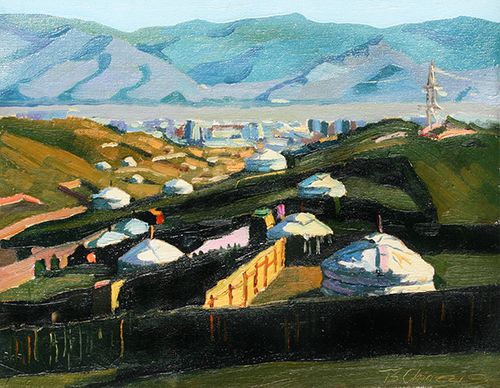
Ger District 3

Chinggis Tulgabaatar , 2008 , Oil On Canvas

This description captures the essence of Chinggis Tulgabaatar’s Ger District 3, a work that serves as a hyper-realistic window into the evolving landscape of Ulaanbaatar.

Overview

Ger District 3 is a masterful exercise in Photorealism, capturing a poignant slice of Mongolian urban life. At a modest scale of 30 x 40 cm, the painting avoids the grandiosity of traditional landscapes to focus instead on the intimate, gritty, and deeply textured reality of the “Ger districts”—the informal settlements where traditional nomadic housing meets the encroaching sprawl of the city.


Visual Composition and Subject Matter

  • The Focal Point: The composition is dominated by the iconic Ger (yurt). Tulgabaatar renders the felt and canvas covers with startling accuracy, showing the subtle sagging of the material, the tension of the ropes (khishig), and the slight weathering caused by the harsh Mongolian climate.

  • The Setting: The Ger is situated within a hashaa (a fenced plot of land). The wooden fences are a study in texture; the artist depicts the splintered grain, the peeling paint, and the mismatched planks that characterize these urban boundaries.

  • Foreground and Groundwork: The ground is often depicted as a mix of packed earth, sparse tufts of hardy grass, and perhaps the remains of winter snow or dust. The level of detail is so high that individual pebbles and the tread of footprints are discernible, grounding the viewer in a specific, tangible moment.

Atmosphere and Light

  • Lighting: Tulgabaatar utilizes a naturalistic, often low-angled light that suggests either the crisp clarity of a Mongolian morning or the long shadows of late afternoon. This light creates a high contrast that defines the spherical volume of the Ger against the linear rigidity of the fences.

  • Color Palette: The palette is intentionally muted and earthy. It is dominated by ochres, dusty browns, slate grays, and the bone-white of the Ger canvas. These “dusty” tones are occasionally punctured by a single vibrant color—perhaps a blue door or a colorful piece of clothing hanging on a line—which emphasizes the “lived-in” nature of the scene.

Style and Technique

  • Photorealistic Execution: The brushwork is nearly invisible. Tulgabaatar uses his training in classical realism to achieve a finish that mimics the depth of field found in photography. The background may be slightly softened (bokeh effect) to draw the eye to the architectural details of the foreground.

  • Figurative Elements: While the focus is often on the architecture of the district, the “portrait” aspect mentioned in the style tags suggests a human presence. If figures are present, they are usually depicted in a moment of quiet labor or stillness, integrated seamlessly into their environment rather than posed.

Symbolism and Context

  • Tradition vs. Modernity: The painting captures the tension between the nomadic soul of Mongolia (the Ger) and the permanent, static nature of the city (the fences and urban grit).

  • Resilience: There is a profound sense of dignity in the rendering. By applying the high-art technique of Photorealism to a “slum” or informal settlement, Tulgabaatar elevates the Ger district from a social issue to a subject of aesthetic beauty and cultural significance.
  • Chinggis Tulgabaatar
  • Geometric, Landscape
  • Oil On Canvas
  • CHI72/047
  • 30 x 40cm

Add Your Comment

Mongolian Art Gallery © 2025. All Rights Reserved
Privacy Policy / Terms of Use

This description captures the essence of Chinggis Tulgabaatar’s Ger District 3, a work that serves as a hyper-realistic window into the evolving landscape of Ulaanbaatar.

Overview

Ger District 3 is a masterful exercise in Photorealism, capturing a poignant slice of Mongolian urban life. At a modest scale of 30 x 40 cm, the painting avoids the grandiosity of traditional landscapes to focus instead on the intimate, gritty, and deeply textured reality of the “Ger districts”—the informal settlements where traditional nomadic housing meets the encroaching sprawl of the city.


Visual Composition and Subject Matter

  • The Focal Point: The composition is dominated by the iconic Ger (yurt). Tulgabaatar renders the felt and canvas covers with startling accuracy, showing the subtle sagging of the material, the tension of the ropes (khishig), and the slight weathering caused by the harsh Mongolian climate.

  • The Setting: The Ger is situated within a hashaa (a fenced plot of land). The wooden fences are a study in texture; the artist depicts the splintered grain, the peeling paint, and the mismatched planks that characterize these urban boundaries.

  • Foreground and Groundwork: The ground is often depicted as a mix of packed earth, sparse tufts of hardy grass, and perhaps the remains of winter snow or dust. The level of detail is so high that individual pebbles and the tread of footprints are discernible, grounding the viewer in a specific, tangible moment.

Atmosphere and Light

  • Lighting: Tulgabaatar utilizes a naturalistic, often low-angled light that suggests either the crisp clarity of a Mongolian morning or the long shadows of late afternoon. This light creates a high contrast that defines the spherical volume of the Ger against the linear rigidity of the fences.

  • Color Palette: The palette is intentionally muted and earthy. It is dominated by ochres, dusty browns, slate grays, and the bone-white of the Ger canvas. These “dusty” tones are occasionally punctured by a single vibrant color—perhaps a blue door or a colorful piece of clothing hanging on a line—which emphasizes the “lived-in” nature of the scene.

Style and Technique

  • Photorealistic Execution: The brushwork is nearly invisible. Tulgabaatar uses his training in classical realism to achieve a finish that mimics the depth of field found in photography. The background may be slightly softened (bokeh effect) to draw the eye to the architectural details of the foreground.

  • Figurative Elements: While the focus is often on the architecture of the district, the “portrait” aspect mentioned in the style tags suggests a human presence. If figures are present, they are usually depicted in a moment of quiet labor or stillness, integrated seamlessly into their environment rather than posed.

Symbolism and Context

  • Tradition vs. Modernity: The painting captures the tension between the nomadic soul of Mongolia (the Ger) and the permanent, static nature of the city (the fences and urban grit).

  • Resilience: There is a profound sense of dignity in the rendering. By applying the high-art technique of Photorealism to a “slum” or informal settlement, Tulgabaatar elevates the Ger district from a social issue to a subject of aesthetic beauty and cultural significance.