
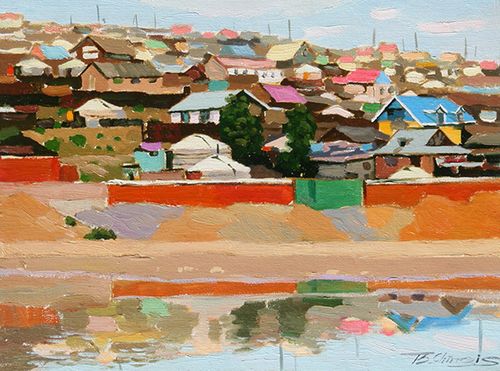
The painting depicts a scene from the Ger District, the sprawling residential areas on the periphery of Ulaanbaatar. True to the “Figurative Art” and “Portrait” tags, the focus is likely a central figure—perhaps an elder or a child—whose presence bridges the gap between the viewer and the landscape.
The Foreground: The artist utilizes hyper-realistic detail to render the textures of the subject’s clothing—often a mix of a traditional deel (Mongolian tunic) paired with modern, weathered accessories. Every crease in the fabric and every nuance of the subject’s skin is treated with clinical precision, typical of Tulgabaatar’s Realism.
The Background: Behind the central figure, the “Ger District” comes to life. You see the iconic white, circular gers (yurts) nestled alongside makeshift wooden fences (khashaa). The haphazard arrangement of power lines, coal-burning chimneys, and perhaps a distant view of Ulaanbaatar’s growing skyline creates a sense of organized chaos.
Atmosphere and Light
The lighting in Ger District 2 is likely stark and naturalistic, mimicking the high-altitude sun of Mongolia.
Color Palette: Dominated by earthy tones—dusty browns, weathered wood greys, and the brilliant, flat white of the ger canvas. These are often contrasted against a piercingly blue Mongolian sky or the hazy, smog-filled horizon typical of winter in the district.
The “Photorealistic” Edge: Tulgabaatar’s technique is so refined that from a distance, the canvas mimics a high-resolution photograph. It is only upon very close inspection that the subtle brushwork and the depth of the oil layers reveal themselves.
Thematic Depth
Beyond the technical skill, the painting serves as a social commentary. By placing a “Portrait” within this specific “Landscape,” Tulgabaatar highlights the human element of Mongolia’s rapid urbanization. The painting isn’t just a depiction of a place; it’s a study of resilience. It captures the dignity of inhabitants living in a transitional space where the nomadic past meets the stationary, industrial future.
Note: As a 2008 work, this represents an earlier period in Tulgabaatar’s career, showcasing the foundation of the meticulous style that has since made him a significant figure in contemporary Mongolian art.