
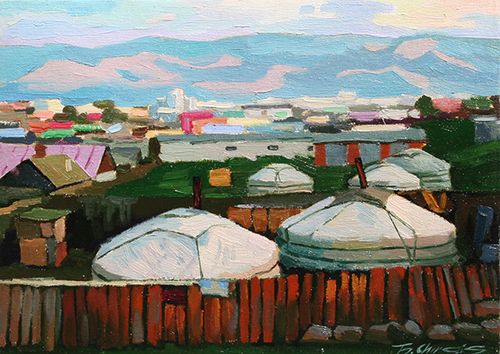
Ger District 1

Chinggis Tulgabaatar , 2008 , Oil On Canvas

In Ger District 1 (2008), Chinggis Tulgabaatar offers a meticulously rendered glimpse into the unique urban fabric of Ulaanbaatar. At just 30 x 40 cm, this oil-on-canvas piece functions like a window, capturing the quiet, gritty, and atmospheric transition between nomadic tradition and sedentary urbanization.

Subject and Composition

The painting depicts a classic scene from Mongolia’s “Ger Districts”—neighborhoods where traditional felt tents (gers) are situated within fenced plots (hashaas) alongside permanent wooden or brick structures.

  • The Focal Point: The viewer’s eye is typically drawn to the pristine white of the ger, which stands in sharp contrast to the weathered, darker tones of the surrounding environment.

  • The Fencing: A prominent feature is the wooden plank fencing. Tulgabaatar uses his photorealistic skill to capture every knot, splinter, and grain in the wood, highlighting the makeshift yet permanent nature of these boundaries.

  • The Landscape: The ground is often depicted as packed earth or dusty pathways, showing the wear of foot traffic and vehicle tires. In the background, the rolling hills surrounding Ulaanbaatar may be visible, often veiled in a soft, hazy light that hints at the city’s notorious winter coal smoke or early morning mist.

Style and Technique

As a master of Photorealism and Realism, Tulgabaatar’s technique is nearly invisible; there are no loose brushstrokes or abstract flourishes.

  • Lighting: The artist excels at capturing natural light. Whether it is the harsh, direct sun of the Mongolian steppe or the soft, diffused glow of dusk, the light creates deep, realistic shadows that give the painting a three-dimensional depth.

  • Texture: The contrast in textures is a hallmark of this work—the soft, heavy felt of the ger against the rough, jagged edges of the wooden fences and the cold, metallic sheen of a distant satellite dish or power line.

  • Figurative Elements: While the landscape dominates, there is often a “figurative” soul to the work. Even if no people are visible, the presence of a propped-up bicycle, a line of laundry, or a wisp of smoke from a chimney suggests a bustling, lived-in reality.

Atmosphere and Meaning

There is a profound sense of stillness and resilience in this piece. By applying the high-prestige style of Photorealism to a “common” or “underprivileged” setting like a ger district, Tulgabaatar elevates the everyday Mongolian experience to the level of fine art. It is a portrait not just of a place, but of a cultural identity in flux.
  • Chinggis Tulgabaatar
  • Geometric, Landscape
  • Oil On Canvas
  • CHI72/045
  • 30 x 40cm

Add Your Comment

Mongolian Art Gallery © 2025. All Rights Reserved
Privacy Policy / Terms of Use

In Ger District 1 (2008), Chinggis Tulgabaatar offers a meticulously rendered glimpse into the unique urban fabric of Ulaanbaatar. At just 30 x 40 cm, this oil-on-canvas piece functions like a window, capturing the quiet, gritty, and atmospheric transition between nomadic tradition and sedentary urbanization.

Subject and Composition

The painting depicts a classic scene from Mongolia’s “Ger Districts”—neighborhoods where traditional felt tents (gers) are situated within fenced plots (hashaas) alongside permanent wooden or brick structures.

  • The Focal Point: The viewer’s eye is typically drawn to the pristine white of the ger, which stands in sharp contrast to the weathered, darker tones of the surrounding environment.

  • The Fencing: A prominent feature is the wooden plank fencing. Tulgabaatar uses his photorealistic skill to capture every knot, splinter, and grain in the wood, highlighting the makeshift yet permanent nature of these boundaries.

  • The Landscape: The ground is often depicted as packed earth or dusty pathways, showing the wear of foot traffic and vehicle tires. In the background, the rolling hills surrounding Ulaanbaatar may be visible, often veiled in a soft, hazy light that hints at the city’s notorious winter coal smoke or early morning mist.

Style and Technique

As a master of Photorealism and Realism, Tulgabaatar’s technique is nearly invisible; there are no loose brushstrokes or abstract flourishes.

  • Lighting: The artist excels at capturing natural light. Whether it is the harsh, direct sun of the Mongolian steppe or the soft, diffused glow of dusk, the light creates deep, realistic shadows that give the painting a three-dimensional depth.

  • Texture: The contrast in textures is a hallmark of this work—the soft, heavy felt of the ger against the rough, jagged edges of the wooden fences and the cold, metallic sheen of a distant satellite dish or power line.

  • Figurative Elements: While the landscape dominates, there is often a “figurative” soul to the work. Even if no people are visible, the presence of a propped-up bicycle, a line of laundry, or a wisp of smoke from a chimney suggests a bustling, lived-in reality.

Atmosphere and Meaning

There is a profound sense of stillness and resilience in this piece. By applying the high-prestige style of Photorealism to a “common” or “underprivileged” setting like a ger district, Tulgabaatar elevates the everyday Mongolian experience to the level of fine art. It is a portrait not just of a place, but of a cultural identity in flux.