
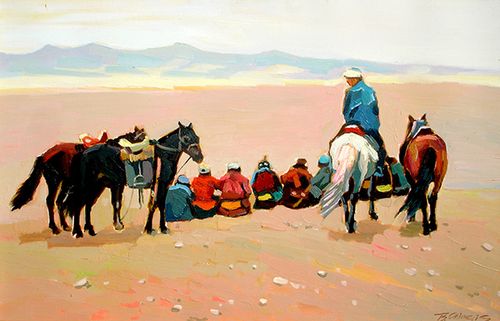
Summer Naadam

Chinggis Tulgabaatar , 2007 , Oil On Canvas

Summer Naadam (2007) is a masterful display of contemporary Mongolian realism. Painted by Chinggis Tulgabaatar when he was just 22 years old, the work captures the soul of Mongolia’s most storied tradition through a lens that is both technically precise and deeply atmospheric.

Composition and Subject Matter

The painting, measuring 40 x 60 cm, utilizes its horizontal orientation to mirror the vastness of the Mongolian steppe. While the title refers to the “Three Games of Men,” Tulgabaatar’s approach is often more intimate and figurative rather than a chaotic wide shot of a stadium.

  • The Focus: The work likely centers on a group of young horse trainers or a singular equestrian figure, grounded in the Figurative Art tradition. The subjects are dressed in vibrant, traditional deels (Mongolian tunics), rendered with such precision that the texture of the silk and the weight of the fabric are palpable.

  • The Landscape: True to the Nature and Landscape styles associated with the artist, the background features the rolling “khangai” (green highlands) under a sprawling, high-altitude summer sky. The grass is not a mere green wash; it is a complex tapestry of yellows, emeralds, and browns, suggesting the heat and dust of the mid-summer festival.

Technical Execution

Tulgabaatar’s background in Photorealism is the defining characteristic of this piece.

  • Light and Shadow: The artist captures the harsh, direct “golden hour” light typical of a Mongolian summer. You can see the sharp highlights on the muscles of the horses and the soft, diffused glow on the faces of the people, highlighting his skill in Portraiture.

  • Texture: Using Oil on Canvas, Tulgabaatar achieves a tactile quality. One can almost feel the coarseness of the horsehair, the weathered skin of the nomadic herders, and the crystalline clarity of the Mongolian air.

  • Color Palette: The palette is dominated by the “Eternal Blue Sky” (Munkh Khukh Tenger) and the vibrant primary colors of the festival attire, contrasted against the earthy, organic tones of the horses and the earth.

Cultural Context

Born and raised in Ulaanbaatar, Chinggis Tulgabaatar represents a generation of Mongolian artists who bridge the gap between traditional nomadic identity and modern academic excellence.

  • Naadam Connection: The painting does not just document a sporting event; it captures the prep and the pride. It honors the relationship between the Mongol and the horse—a bond that is central to the nation’s identity.

  • Realism as Respect: By choosing Realism, Tulgabaatar avoids romanticizing or abstracting his culture. Instead, he presents it with a clarity that demands the viewer acknowledge the dignity and reality of modern nomadic life.

Note: At 40 x 60 cm, this is an intimate piece intended for close viewing, allowing the observer to get lost in the micro-details of the embroidery and the anatomy of the livestock.

  • Chinggis Tulgabaatar
  • Figurative, Photorealism
  • Oil On Canvas
  • CHI72/039
  • 40 x 60cm
  • Mongolian Art Gallery

Add Your Comment

Mongolian Art Gallery © 2025. All Rights Reserved
Privacy Policy / Terms of Use

Summer Naadam (2007) is a masterful display of contemporary Mongolian realism. Painted by Chinggis Tulgabaatar when he was just 22 years old, the work captures the soul of Mongolia’s most storied tradition through a lens that is both technically precise and deeply atmospheric.

Composition and Subject Matter

The painting, measuring 40 x 60 cm, utilizes its horizontal orientation to mirror the vastness of the Mongolian steppe. While the title refers to the “Three Games of Men,” Tulgabaatar’s approach is often more intimate and figurative rather than a chaotic wide shot of a stadium.

  • The Focus: The work likely centers on a group of young horse trainers or a singular equestrian figure, grounded in the Figurative Art tradition. The subjects are dressed in vibrant, traditional deels (Mongolian tunics), rendered with such precision that the texture of the silk and the weight of the fabric are palpable.

  • The Landscape: True to the Nature and Landscape styles associated with the artist, the background features the rolling “khangai” (green highlands) under a sprawling, high-altitude summer sky. The grass is not a mere green wash; it is a complex tapestry of yellows, emeralds, and browns, suggesting the heat and dust of the mid-summer festival.

Technical Execution

Tulgabaatar’s background in Photorealism is the defining characteristic of this piece.

  • Light and Shadow: The artist captures the harsh, direct “golden hour” light typical of a Mongolian summer. You can see the sharp highlights on the muscles of the horses and the soft, diffused glow on the faces of the people, highlighting his skill in Portraiture.

  • Texture: Using Oil on Canvas, Tulgabaatar achieves a tactile quality. One can almost feel the coarseness of the horsehair, the weathered skin of the nomadic herders, and the crystalline clarity of the Mongolian air.

  • Color Palette: The palette is dominated by the “Eternal Blue Sky” (Munkh Khukh Tenger) and the vibrant primary colors of the festival attire, contrasted against the earthy, organic tones of the horses and the earth.

Cultural Context

Born and raised in Ulaanbaatar, Chinggis Tulgabaatar represents a generation of Mongolian artists who bridge the gap between traditional nomadic identity and modern academic excellence.

  • Naadam Connection: The painting does not just document a sporting event; it captures the prep and the pride. It honors the relationship between the Mongol and the horse—a bond that is central to the nation’s identity.

  • Realism as Respect: By choosing Realism, Tulgabaatar avoids romanticizing or abstracting his culture. Instead, he presents it with a clarity that demands the viewer acknowledge the dignity and reality of modern nomadic life.

Note: At 40 x 60 cm, this is an intimate piece intended for close viewing, allowing the observer to get lost in the micro-details of the embroidery and the anatomy of the livestock.