
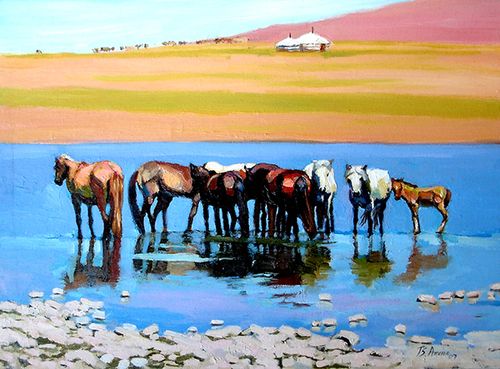
Countryside 3

Chinggis Tulgabaatar , 2007 , Oil On Canvas

Countryside 3 is a masterful 2007 oil-on-canvas work by the contemporary Mongolian artist Chinggis Tulgabaatar. Created when the artist was just 22 years old, the piece serves as a sophisticated testament to his early technical prowess and his deep-seated connection to the Mongolian landscape and its people.

Visual Composition and Style

Tulgabaatar balances several demanding styles in this piece, blending the clinical precision of Photorealism with the emotive weight of Figurative Art.

  • The Landscape: Given the title and Tulgabaatar’s heritage, the painting likely depicts the expansive Mongolian steppe. The “Countryside” series is known for capturing the specific, golden-hour light that defines the high-altitude plains. The horizon line is likely positioned to emphasize the vastness of the sky or the rolling texture of the earth.

  • The Figure: Because the work is categorized under both Portrait and Figurative Art, the composition likely features a central human figure. In Tulgabaatar’s work, these figures—often nomadic children or elders—are rendered with startling clarity, from the weathered texture of their skin to the intricate patterns of traditional Mongolian garments (deel).

  • Color Palette: Expect a sophisticated use of earthy ochres, deep burnt siennas, and the sharp, brilliant blues of the “Eternal Blue Sky” (Munkh Khukh Tenger). The oil medium allows for the smooth gradients necessary to achieve a photorealistic sky.

Technical Mastery: Oil on Canvas

At 41 x 54 cm, the painting is relatively intimate. This scale invites the viewer to step closer, where the “Photorealism” reveals its secrets. Tulgabaatar uses the slow-drying nature of oil paint to create:

  • Micro-textures: The frayed edges of a coat or the individual blades of dry grass.

  • Atmospheric Perspective: A sense of immense distance created through subtle shifts in color saturation and clarity.

  • Light Play: The way light catches the cheekbones of the subject or the crest of a distant hill.

Thematic Significance

Born in Ulaanbaatar, Tulgabaatar belongs to a generation of Mongolian artists who bridge the gap between ancient nomadic traditions and the modern, globalized world. Countryside 3 is more than just a “pretty picture” of the outdoors; it is an exploration of:

  1. Identity: How the Mongolian spirit is tethered to the land.

  2. Quietude: A rejection of the urban chaos of the capital in favor of the rhythmic, silent life of the countryside.

  3. Realism as Truth: By using such high detail, the artist asserts that these rural scenes are not myths or “folklore,” but a vivid, breathing reality.

Artist Snapshot: Chinggis Tulgabaatar

  • Born: 1985, Ulaanbaatar.

  • Context: His work often features themes of childhood and the purity of nature, frequently utilizing a hyper-realistic lens that makes the viewer feel they could reach out and touch the canvas.

Note: In the context of 2007, this piece marked Tulgabaatar as a rising star in the Mongolian art scene, contributing to the “New Realism” movement that gained international traction shortly thereafter.
  • Chinggis Tulgabaatar
  • Landscape, Photorealism
  • Oil On Canvas
  • CHI72/037
  • 41 x 54cm
  • Mongolian Art Gallery

Add Your Comment

Mongolian Art Gallery © 2025. All Rights Reserved
Privacy Policy / Terms of Use

Countryside 3 is a masterful 2007 oil-on-canvas work by the contemporary Mongolian artist Chinggis Tulgabaatar. Created when the artist was just 22 years old, the piece serves as a sophisticated testament to his early technical prowess and his deep-seated connection to the Mongolian landscape and its people.

Visual Composition and Style

Tulgabaatar balances several demanding styles in this piece, blending the clinical precision of Photorealism with the emotive weight of Figurative Art.

  • The Landscape: Given the title and Tulgabaatar’s heritage, the painting likely depicts the expansive Mongolian steppe. The “Countryside” series is known for capturing the specific, golden-hour light that defines the high-altitude plains. The horizon line is likely positioned to emphasize the vastness of the sky or the rolling texture of the earth.

  • The Figure: Because the work is categorized under both Portrait and Figurative Art, the composition likely features a central human figure. In Tulgabaatar’s work, these figures—often nomadic children or elders—are rendered with startling clarity, from the weathered texture of their skin to the intricate patterns of traditional Mongolian garments (deel).

  • Color Palette: Expect a sophisticated use of earthy ochres, deep burnt siennas, and the sharp, brilliant blues of the “Eternal Blue Sky” (Munkh Khukh Tenger). The oil medium allows for the smooth gradients necessary to achieve a photorealistic sky.

Technical Mastery: Oil on Canvas

At 41 x 54 cm, the painting is relatively intimate. This scale invites the viewer to step closer, where the “Photorealism” reveals its secrets. Tulgabaatar uses the slow-drying nature of oil paint to create:

  • Micro-textures: The frayed edges of a coat or the individual blades of dry grass.

  • Atmospheric Perspective: A sense of immense distance created through subtle shifts in color saturation and clarity.

  • Light Play: The way light catches the cheekbones of the subject or the crest of a distant hill.

Thematic Significance

Born in Ulaanbaatar, Tulgabaatar belongs to a generation of Mongolian artists who bridge the gap between ancient nomadic traditions and the modern, globalized world. Countryside 3 is more than just a “pretty picture” of the outdoors; it is an exploration of:

  1. Identity: How the Mongolian spirit is tethered to the land.

  2. Quietude: A rejection of the urban chaos of the capital in favor of the rhythmic, silent life of the countryside.

  3. Realism as Truth: By using such high detail, the artist asserts that these rural scenes are not myths or “folklore,” but a vivid, breathing reality.

Artist Snapshot: Chinggis Tulgabaatar

  • Born: 1985, Ulaanbaatar.

  • Context: His work often features themes of childhood and the purity of nature, frequently utilizing a hyper-realistic lens that makes the viewer feel they could reach out and touch the canvas.

Note: In the context of 2007, this piece marked Tulgabaatar as a rising star in the Mongolian art scene, contributing to the “New Realism” movement that gained international traction shortly thereafter.