

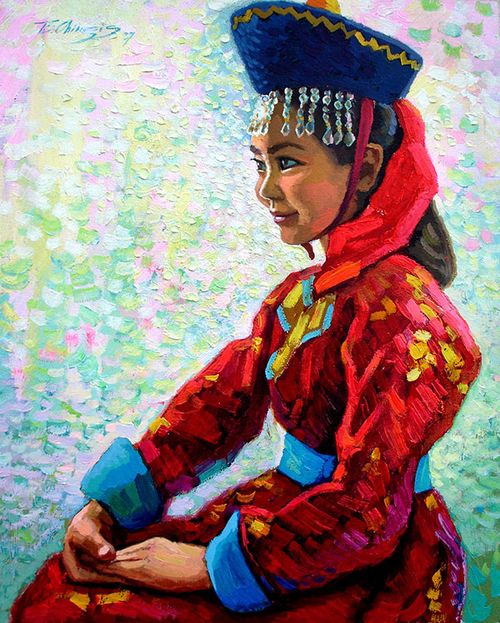
In “Lady,” Tulgabaatar utilizes the 50 x 40 cm format to create a sense of intimacy. The composition is a classic portrait, focusing on the head and shoulders of a Mongolian woman. True to the Photorealism style, the artist avoids the “painterly” brushstrokes often seen in traditional oil works, instead opting for a finish so smooth it mimics the clarity of a high-resolution photograph.
The “Lady” herself is often depicted with a gaze that is both piercing and serene. Her features are rendered with anatomical precision—from the subtle moisture on the lips to the fine, individual strands of hair caught in the light.
The Interplay of Nature and Landscape
While the focus is Figurative Art, Tulgabaatar integrates Nature and Landscape elements, a hallmark of his Mongolian heritage.
The Background: Rather than a studio backdrop, the artist frequently places his subjects against the vast, soft-focus landscapes of the Mongolian steppe or beneath a sky that suggests a specific time of day (often the “golden hour”).
Lighting: The light in the painting feels organic. It isn’t the harsh, artificial light of a gallery, but rather the diffuse, warm glow of the outdoors, which emphasizes the texture of her skin and any traditional silk or wool textures in her clothing.
Style and Technique
The work is a showcase of Realism. Tulgabaatar’s ability to handle oil paint allows him to capture:
Textural Contrast: The difference between the softness of the skin and the weight of fabric.
Atmospheric Perspective: A sense of depth that makes the “Lady” feel as though she is occupying a three-dimensional space rather than sitting on a flat canvas.
Cultural Identity: While the techniques are rooted in Western Photorealism, the “soul” of the painting is deeply Mongolian, reflecting a quiet strength and a connection to the natural world.
About the Artist
Born in Ulaanbaatar in 1985, Chinggis Tulgabaatar is part of a generation of Mongolian artists who have gained international acclaim for their technical virtuosity. His work often explores the delicate balance between Mongolia’s nomadic traditions and the modernizing pulse of its capital city. “Lady” remains a definitive early example of his ability to capture human emotion through the lens of meticulous detail.