
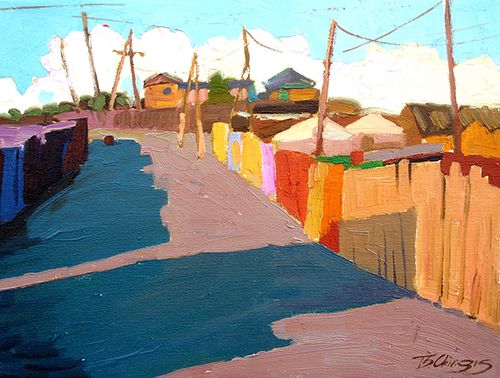
At 30 x 40 cm, the work is intimate, forcing the viewer to lean in and appreciate the photorealistic precision Tulgabaatar employs.
The Subject Matter: The painting likely depicts a khashaa (a fenced plot of land). In these districts, the iconic white, circular Gers (traditional Mongolian felt tents) sit alongside makeshift wooden houses and coal-burning stoves.
Color Palette: Expect a contrast between the stark, brilliant white of the Ger canvas and the “earthy” grime of the district. Tulgabaatar often uses muted ochres, dusty browns, and the crisp, high-altitude blue of the Mongolian sky.
Light and Texture: The “Photorealism” tag suggests a high level of detail in the textures—the rough grain of weathered wooden fences, the soft pile of felt on the Ger, and perhaps the haze of coal smoke that often hangs over these districts in the winter.
Figurative Elements: While it is a landscape, the inclusion of “Portrait” and “Figurative Art” styles suggests a human presence. This might be a solitary figure—perhaps an elder or a child—whose expression reflects the resilience required to live in the harsh, sub-arctic climate of Ulaanbaatar.
Thematic Context: The “Ger District”
To understand the painting, one must understand the subject. The Ger Districts of Ulaanbaatar are unique urban ecosystems. They are not quite “slums” in the traditional sense, but rather semi-formal residential zones where nomadic traditions meet fixed urban life.
Artist Insight: Tulgabaatar, born and raised in Ulaanbaatar, captures these areas not with a sense of pity, but with a profound Realism. By categorizing this as “Nature” alongside “Landscape,” he suggests that the Ger is as much a part of the Mongolian environment as the mountains themselves.
Artistic Style: The Tulgabaatar Touch
Chinggis Tulgabaatar is known for his ability to make oil paint look like a high-definition photograph. His work in 2007 marked a period where Mongolian contemporary art was balancing its socialist-realist roots with a new, globalized lens.
Realism vs. Photorealism: While realism seeks to depict the world as it is, Tulgabaatar’s photorealistic approach in this piece ensures that every wrinkle in a face or every splinter in a fence is accounted for, elevating a “common” scene into a moment of high art.
Landscape & Portrait Fusion: The painting likely uses the vastness of the Mongolian landscape to frame the intimacy of the Ger, creating a sense of “belonging” despite the harsh conditions.