
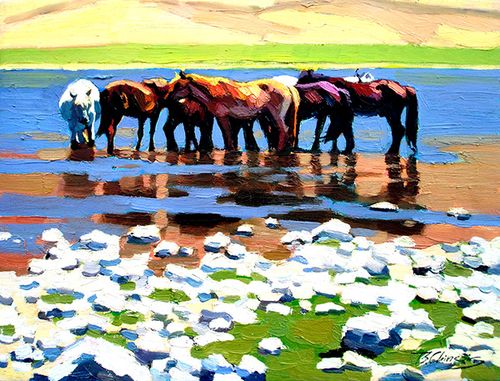
Countryside 1 is a masterful exploration of the Mongolian landscape through the lens of Contemporary Realism. Painted in 2007, this work serves as a testament to Chinggis Tulgabaatar’s technical precision and his deep-seated connection to his heritage. Despite its modest dimensions of 30 x 40cm, the painting manages to capture the vastness and atmospheric weight of the Mongolian steppe.
Visual Description & Composition
In this piece, Tulgabaatar employs a Photorealistic approach to depict a serene rural scene. The composition likely balances the immense, open sky—characteristic of the “Land of the Eternal Blue Sky”—with the rugged textures of the earth.
The Landscape: The foreground likely features the sparse, golden-hued grasses of the steppe, rendered with such fine detail that individual blades appear to sway in the wind. The mid-ground may include traditional elements, such as a solitary ger (yurt) or livestock, providing a focal point that emphasizes the scale of the environment.
Atmosphere and Light: Tulgabaatar is known for his ability to manipulate light. In Countryside 1, the light is likely soft and directional, perhaps mimicking the “golden hour” of a late Mongolian afternoon. This creates long, gentle shadows that give the 2D canvas a profound sense of 3D depth.
Color Palette: Expect a sophisticated use of earth tones—ochres, burnt siennas, and muted greens—contrasted against a crisp, high-altitude blue or a dramatic, cloud-heavy sky.
Style and Technique
Chinggis Tulgabaatar’s style is a bridge between Classical Realism and modern Photorealism.
Oil on Canvas: His use of oils allows for rich layering and smooth gradients, particularly in the sky and skin tones (if figurative elements are present).
Figurative Elements: Given his background in Portraiture, any human or animal figures in the work would be rendered with anatomical exactitude, capturing not just a likeness, but a sense of quiet dignity and endurance.
Cultural Context: While the technique is Western in origin, the soul of the painting is inherently Mongolian. It avoids the “romanticized” exoticism often seen in travel photography, opting instead for a grounded, honest portrayal of country life.
About the Artist: Chinggis Tulgabaatar
Born in 1985 in Ulaanbaatar, Tulgabaatar belongs to a generation of Mongolian artists who have refined the academic realist traditions passed down through Soviet influence, infusing them with a distinct national identity. His work is characterized by:
Meticulous Detail: A devotion to the “truth” of the subject matter.
Versatility: Seamlessly moving between expansive Landscapes and intimate Portraits.
Emotional Stillness: His paintings often evoke a sense of silence, inviting the viewer to pause and breathe in the painted air.