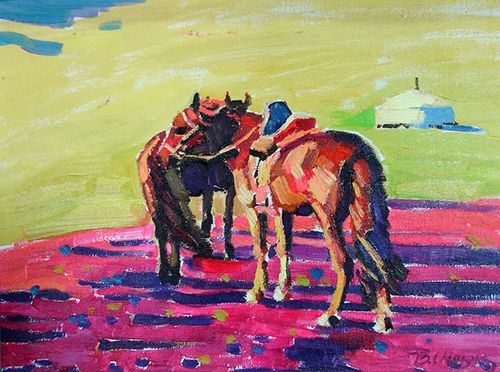
Twin Horse3

Chinggis Tulgabaatar , 2007 , Oil On Canvas

This is a striking example of contemporary Mongolian realism. Even at a relatively modest size of 30 x 40 cm, Twin Horse3 serves as a high-definition window into the soul of the Mongolian steppe. Created in 2007, this piece represents an early peak in Chinggis Tulgabaatar’s career, blending meticulous technical skill with a deep, cultural reverence for his subject.

Artwork Overview

  • Title: Twin Horse3

  • Artist: Chinggis Tulgabaatar (b. 1985, Ulaanbaatar)

  • Date: 2007

  • Medium: Oil on canvas

  • Dimensions: 30 x 40 cm

  • Styles: Photorealism, Realism, Figurative Art, Landscape

Visual Description & Composition

The Subjects: A Study in Kinship

The “Twin” in the title suggests a Mirror-like symmetry or a deep bond between the two animals. In this figurative portrait, the horses are likely positioned in close proximity—perhaps their necks overlapping or their heads turned toward one another.

Given Tulgabaatar’s mastery of Photorealism, the focus is intensely granular:

  • The Coats: Expect to see the individual sheen of every hair, with light catching the ripple of muscle beneath the skin.

  • The Eyes: A hallmark of Tulgabaatar’s work is the “glassy” realism of the eyes, which often reflect the vast, open horizon of the Mongolian landscape.

  • Expression: Unlike traditional “wild horse” paintings that focus on chaotic movement, this piece leans into the Portrait style, capturing a moment of stillness, intelligence, and stoic grace.

Color Palette and Light

The artist utilizes a sophisticated palette of earth tones—burnt sienna, ochre, and deep umber—contrasted against the cool, ethereal blues or muted straws of the Mongolian sky and grass.

  • Directional Light: The 2007 period of his work often features a strong “golden hour” light source, casting long shadows and highlighting the textural contrast between the soft manes and the tough, weathered hides of the horses.

The Landscape Background

While the horses are the central “figurative” elements, the Nature/Landscape aspect is not ignored. The background is likely rendered with a slight soft-focus (bokeh) effect to pull the viewers’ eyes toward the sharp details of the horses, yet it still conveys the immense scale of the Ulaanbaatar outskirts—vast, unpopulated, and timeless.

Artistic Context

Chinggis Tulgabaatar was only 22 years old when he painted this. Born and raised in Ulaanbaatar, his work is a bridge between the traditional nomadic importance of the horse and a modern, almost clinical obsession with visual accuracy.

  • Photorealism vs. Realism: While the painting looks like a photograph at a distance, the “Realism” tag applies to the spirit of the work—it doesn’t sanitize the animals. It likely captures the dust in the manes or the slight scarring on the hide, presenting the horse not as a myth, but as a living, breathing entity.

  • Scale: At 30 x 40 cm, this is an intimate viewing experience. It invites the viewer to step close to the canvas, mirroring the physical closeness of the two horses depicted.
  • Chinggis Tulgabaatar
  • Figurative, Mongolian Style
  • Oil On Canvas
  • CHI72/024
  • 30 x 40cm

Add Your Comment

Mongolian Art Gallery © 2025. All Rights Reserved
Privacy Policy / Terms of Use

This is a striking example of contemporary Mongolian realism. Even at a relatively modest size of 30 x 40 cm, Twin Horse3 serves as a high-definition window into the soul of the Mongolian steppe. Created in 2007, this piece represents an early peak in Chinggis Tulgabaatar’s career, blending meticulous technical skill with a deep, cultural reverence for his subject.

Artwork Overview

  • Title: Twin Horse3

  • Artist: Chinggis Tulgabaatar (b. 1985, Ulaanbaatar)

  • Date: 2007

  • Medium: Oil on canvas

  • Dimensions: 30 x 40 cm

  • Styles: Photorealism, Realism, Figurative Art, Landscape

Visual Description & Composition

The Subjects: A Study in Kinship

The “Twin” in the title suggests a Mirror-like symmetry or a deep bond between the two animals. In this figurative portrait, the horses are likely positioned in close proximity—perhaps their necks overlapping or their heads turned toward one another.

Given Tulgabaatar’s mastery of Photorealism, the focus is intensely granular:

  • The Coats: Expect to see the individual sheen of every hair, with light catching the ripple of muscle beneath the skin.

  • The Eyes: A hallmark of Tulgabaatar’s work is the “glassy” realism of the eyes, which often reflect the vast, open horizon of the Mongolian landscape.

  • Expression: Unlike traditional “wild horse” paintings that focus on chaotic movement, this piece leans into the Portrait style, capturing a moment of stillness, intelligence, and stoic grace.

Color Palette and Light

The artist utilizes a sophisticated palette of earth tones—burnt sienna, ochre, and deep umber—contrasted against the cool, ethereal blues or muted straws of the Mongolian sky and grass.

  • Directional Light: The 2007 period of his work often features a strong “golden hour” light source, casting long shadows and highlighting the textural contrast between the soft manes and the tough, weathered hides of the horses.

The Landscape Background

While the horses are the central “figurative” elements, the Nature/Landscape aspect is not ignored. The background is likely rendered with a slight soft-focus (bokeh) effect to pull the viewers’ eyes toward the sharp details of the horses, yet it still conveys the immense scale of the Ulaanbaatar outskirts—vast, unpopulated, and timeless.

Artistic Context

Chinggis Tulgabaatar was only 22 years old when he painted this. Born and raised in Ulaanbaatar, his work is a bridge between the traditional nomadic importance of the horse and a modern, almost clinical obsession with visual accuracy.

  • Photorealism vs. Realism: While the painting looks like a photograph at a distance, the “Realism” tag applies to the spirit of the work—it doesn’t sanitize the animals. It likely captures the dust in the manes or the slight scarring on the hide, presenting the horse not as a myth, but as a living, breathing entity.

  • Scale: At 30 x 40 cm, this is an intimate viewing experience. It invites the viewer to step close to the canvas, mirroring the physical closeness of the two horses depicted.