

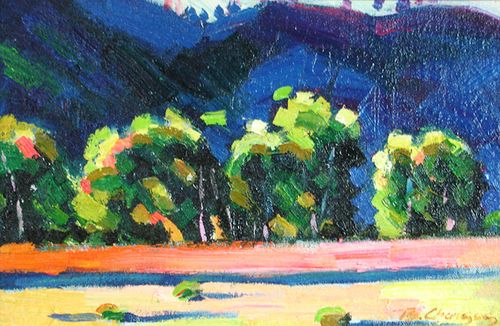
The painting features a solitary tree, centered and isolated against a backdrop that shifts between the natural world and a soft, atmospheric void. By applying the principles of Figurative Art to a non-human subject, Tulgabaatar gives the tree a “personality.”
The Trunk: Rendered with obsessive detail, every fissure and flake of bark is visible, showcasing the artist’s dedication to Photorealism.
The Branches: They reach out with a skeletal, almost nervous energy, creating a complex web that plays with light and shadow.
Scale: The 25 x 30 cm format forces the viewer to move closer, transforming the act of looking into an intimate, private conversation between the viewer and the object.
Light and Color
Tulgabaatar often utilizes a palette that reflects the high-contrast, sharp light found in the Mongolian landscape.
Chiaroscuro effects: There is a dramatic interplay between the illuminated side of the trunk and the deep, recessed shadows within the foliage.
Atmospheric Realism: The colors are grounded in earthy tones—umbers, siennas, and muted greys—giving the piece a timeless, somber quality that transcends a simple “nature study.”
Style and Technique
Photorealism & Realism
While many artists use Photorealism to create a cold, mechanical copy of a photograph, Tulgabaatar uses it to achieve heightened awareness. By capturing details the human eye might overlook in passing—the specific moss on a root or the way light catches a single leaf—he elevates the mundane to the level of the sacred.
The Mongolian Context
Born in Ulaanbaatar in 1985, Tulgabaatar belongs to a generation of Mongolian artists who blend traditional sensibilities with contemporary Western techniques. In “Tree,” there is a subtle nod to the vastness of the Mongolian steppe; even when focusing on a single plant, the sense of isolation and the resilience of life in a harsh climate is palpable.
