
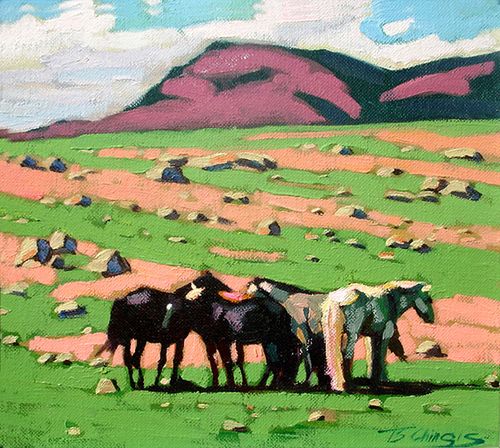
Painted in 2007, Green Steppe is a profound example of Chinggis Tulgabaatar’s ability to bridge the gap between human intimacy and the vastness of the natural world. Despite its modest dimensions (25 x 30 cm), the work carries the weight of an epic, capturing a specific, quiet moment in the Mongolian highlands with surgical precision.
Visual Composition and Subject Matter
The painting serves as a synthesis of Portraiture and Landscape. Given the associated style of “Figurative Art,” the composition likely centers on a singular figure—often a child or a nomadic elder—set against the rolling, verdant horizons of the Mongolian steppe.
The Foreground: Tulgabaatar utilizes his mastery of Photorealism to render the textures of the steppe. Every blade of grass and wildflower is depicted with such clarity that the viewer can almost feel the cool, thin mountain air. If a figure is present, the artist typically focuses on the weathered texture of traditional deel (Mongolian clothing) and the sun-kissed, rosy complexion characteristic of those living in high-altitude environments.
The Background: The “Green Steppe” of the title refers to the endless undulating hills that fade into a soft, hazy blue on the horizon. The artist uses atmospheric perspective to create a sense of infinite space within a very small canvas, a testament to his technical skill.
Style and Technique: The Photorealist Edge
Tulgabaatar’s work is characterized by a “hyper-focus” that goes beyond mere photography. By using oil on canvas, he achieves a depth of color and light that a camera often flattens.
Chiaroscuro and Light: The lighting in Green Steppe often mimics the “golden hour” or the sharp, direct light of a Mongolian afternoon, creating high-contrast shadows that give the figure and the terrain a three-dimensional, sculptural quality.
Scale and Detail: At only 25 x 30 cm, the painting demands that the viewer step closer. This creates an intimate dialogue; the vastness of the landscape is contained within a “window” no larger than a standard sheet of paper.
Color Palette: The palette is dominated by viridians, sap greens, and earthy ochres, punctuated by the vibrant blues of the Mongolian sky (the “Land of the Eternal Blue Sky”).
Cultural Significance
Born in Ulaanbaatar in 1985, Tulgabaatar belongs to a generation of artists who reclaimed the realist tradition to celebrate Mongolian identity. Green Steppe is not just a technical exercise in Realism; it is a meditation on the relationship between the nomadic spirit and the environment. It captures the stillness of a landscape that is both a home and a sacred space.