
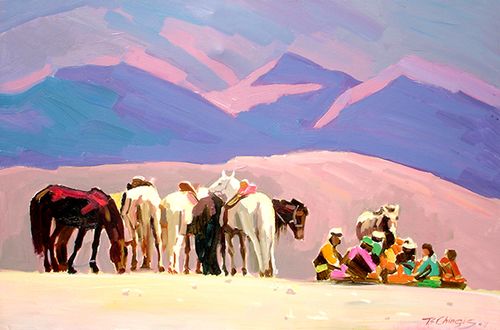
Created in 2007, Naadam is a compelling testament to the early mastery of Chinggis Tulgabaatar. Painted when the artist was just 22 years old, the work captures the essence of Mongolia’s most significant cultural festival—the “Three Manly Games” (wrestling, horse racing, and archery). Through a sophisticated blend of Photorealism and Figurative Art, Tulgabaatar transcends simple documentation, offering a window into the soul of Mongolian heritage.
Composition and Style
The painting utilizes a 40 x 60 cm format to create an intimate yet expansive view of the Mongolian landscape. Tulgabaatar employs a Realist approach that honors the vastness of the steppe while focusing intently on human presence.
The Figurative Focus: The central figures are rendered with anatomical precision, showcasing the artist’s skill in Portraiture. Whether capturing the tensed muscles of a wrestler or the focused gaze of an archer, the figures feel grounded and alive.
The Landscape: The Nature elements are not merely a backdrop but a character in themselves. The light play across the grass and the distant horizon reflects the unique atmospheric quality of the Mongolian highlands, a hallmark of Tulgabaatar’s stylistic dedication to his homeland.
Technique and Color
Working in Oil on canvas, the artist utilizes fine brushwork to achieve a Photorealistic finish.
Color Palette: Expect a rich dialogue between the earthy ochres of the terrain and the vibrant, saturated silks of traditional deels (Mongolian tunics).
Light: There is a cinematic quality to the light, suggesting either the sharp clarity of a high-altitude morning or the long, golden shadows of a late afternoon on the plains.
Cultural Significance
As a native of Ulaanbaatar, Tulgabaatar captures Naadam not as a tourist spectacle, but as a living pulse of national identity. The 2007 piece serves as a bridge between the ancient traditions of the nomads and the contemporary technical prowess of a rising Mongolian art star. It is a celebration of strength, community, and the enduring bond between the people and their land.