Red Horses

Chinggis Tulgabaatar , 2007 , Oil On Canvas

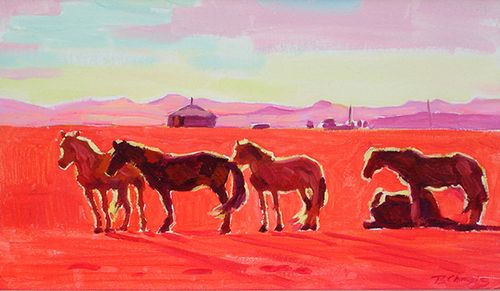
Chinggis Tulgabaatar’s 2007 masterpiece, “Red Horses,” is a striking intersection of Mongolian heritage and technical precision. At just 30 x 50cm, this oil-on-canvas work packs an immense amount of atmospheric power into a relatively intimate frame.

The Artist: Chinggis Tulgabaatar

Born in 1985 in Ulaanbaatar, Mongolia, Tulgabaatar belongs to a generation of Mongolian artists who masterfully blend traditional nomadic motifs with Western academic techniques. His work is often characterized by an obsessive attention to detail, earning him associations with Photorealism and Realism.

Visual Analysis and Composition

1. Subject and Movement The painting captures a group of horses—rendered in a vibrant, earthy red palette—moving across a vast landscape. Tulgabaatar utilizes Figurative Art principles to ensure each horse is anatomically perfect, capturing the tension in their muscles and the fluid motion of their manes. The “red” of the horses is not merely a flat color but a layered exploration of ochre, sienna, and deep crimson, suggesting the warmth of the animals against a cooler background.

2. Style: Photorealism meets Landscape While the horses are the focal point, the Landscape is equally vital. Tulgabaatar’s Photorealistic approach is evident in how he renders light reflecting off the horses’ coats and the subtle textures of the Mongolian steppe. The scale (30 x 50cm) forces the viewer to lean in, discovering minute details like the dust kicked up by hooves or the specific glint in a horse’s eye.

3. Atmosphere and Lighting The work leans into Nature and Portraiture—treating the horses not just as animals, but as subjects with individual presence. The lighting often suggests a “golden hour” or a hazy atmospheric perspective, which softens the hard edges of realism and adds a sense of timelessness to the scene.

Artistic Significance

“Red Horses” serves as a bridge between the artist’s roots and contemporary global art trends. By applying Photorealism to a subject as ancient as the Mongolian horse, Tulgabaatar elevates the animal to a symbol of national identity and natural grace.

  • Color Palette: Dominated by warm earth tones (reds, browns) contrasted against the neutral, expansive tones of the sky and earth.

  • Technique: Fine-brush oil work with a focus on light-play and texture.
  • Chinggis Tulgabaatar
  • Landscape, Realism
  • Oil On Canvas
  • CHI72/014
  • 30 x 50cm

Add Your Comment

Mongolian Art Gallery © 2025. All Rights Reserved
Privacy Policy / Terms of Use

Chinggis Tulgabaatar’s 2007 masterpiece, “Red Horses,” is a striking intersection of Mongolian heritage and technical precision. At just 30 x 50cm, this oil-on-canvas work packs an immense amount of atmospheric power into a relatively intimate frame.

The Artist: Chinggis Tulgabaatar

Born in 1985 in Ulaanbaatar, Mongolia, Tulgabaatar belongs to a generation of Mongolian artists who masterfully blend traditional nomadic motifs with Western academic techniques. His work is often characterized by an obsessive attention to detail, earning him associations with Photorealism and Realism.

Visual Analysis and Composition

1. Subject and Movement The painting captures a group of horses—rendered in a vibrant, earthy red palette—moving across a vast landscape. Tulgabaatar utilizes Figurative Art principles to ensure each horse is anatomically perfect, capturing the tension in their muscles and the fluid motion of their manes. The “red” of the horses is not merely a flat color but a layered exploration of ochre, sienna, and deep crimson, suggesting the warmth of the animals against a cooler background.

2. Style: Photorealism meets Landscape While the horses are the focal point, the Landscape is equally vital. Tulgabaatar’s Photorealistic approach is evident in how he renders light reflecting off the horses’ coats and the subtle textures of the Mongolian steppe. The scale (30 x 50cm) forces the viewer to lean in, discovering minute details like the dust kicked up by hooves or the specific glint in a horse’s eye.

3. Atmosphere and Lighting The work leans into Nature and Portraiture—treating the horses not just as animals, but as subjects with individual presence. The lighting often suggests a “golden hour” or a hazy atmospheric perspective, which softens the hard edges of realism and adds a sense of timelessness to the scene.

Artistic Significance

“Red Horses” serves as a bridge between the artist’s roots and contemporary global art trends. By applying Photorealism to a subject as ancient as the Mongolian horse, Tulgabaatar elevates the animal to a symbol of national identity and natural grace.

  • Color Palette: Dominated by warm earth tones (reds, browns) contrasted against the neutral, expansive tones of the sky and earth.

  • Technique: Fine-brush oil work with a focus on light-play and texture.