
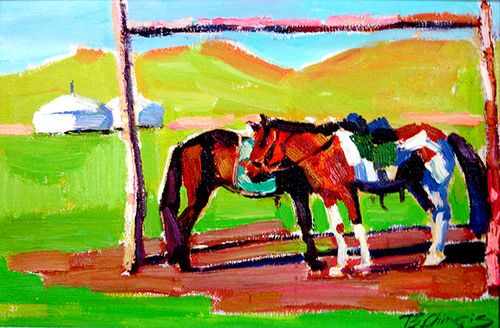
Twin Horse

Chinggis Tulgabaatar , 2007 , Oil On Canvas

The painting “Twin Horse” (2007) by Chinggis Tulgabaatar is a masterful exploration of the deep-seated connection between Mongolian heritage and the natural world. Despite its modest dimensions (26 x 33 cm), the work carries a monumental presence, blending meticulous photorealism with a soulful, figurative approach.

Visual Composition & Style

Tulgabaatar utilizes oil on canvas to achieve a surface quality that bridges the gap between a high-resolution photograph and a classical portrait. The composition centers on two horses—likely the iconic Przewalski’s horse or the hardy native Mongolian breed—captured in a moment of quiet intimacy.

  • Photorealism & Detail: The artist’s technical prowess is evident in the rendering of the horses’ coats. Every strand of the mane, the velvet texture of the muzzles, and the moisture in their eyes are depicted with clinical precision. This level of detail elevates the animals from mere subjects to “portraits,” giving them a sense of individual consciousness.

  • The “Twin” Motif: The horses are positioned closely, their forms overlapping. This creates a rhythmic symmetry that suggests a “twin” or mirror-like bond. It evokes themes of companionship, survival, and the duality of nature.

  • Landscape & Light: While the horses are the primary focus, the background hints at the vast, ethereal Mongolian steppe. Tulgabaatar uses a soft, naturalistic palette—earthy browns, ochres, and muted sky tones—to ground the subjects in their native environment.

The Artist: Chinggis Tulgabaatar

Born in 1985 in Ulaanbaatar, Tulgabaatar belongs to a generation of Mongolian artists who successfully fuse traditional nomadic themes with contemporary Western techniques.

  • Cultural Context: In Mongolia, the horse is a sacred symbol of freedom and national identity. By applying Realism and Photorealism to this subject in 2007, Tulgabaatar moved away from the more abstract or “Mongol Zurag” styles of the past, opting instead for a literalism that honors the physical reality of the steppe.

  • Formative Period: At the time of this painting, Tulgabaatar was in his early twenties, establishing his reputation for “Figurative Art” that captures the essence of life with startling clarity.

  • Chinggis Tulgabaatar
  • Minimalist, Photorealism
  • Oil On Canvas
  • CHI72/010
  • 26 x 33cm

Add Your Comment

Mongolian Art Gallery © 2025. All Rights Reserved
Privacy Policy / Terms of Use

The painting “Twin Horse” (2007) by Chinggis Tulgabaatar is a masterful exploration of the deep-seated connection between Mongolian heritage and the natural world. Despite its modest dimensions (26 x 33 cm), the work carries a monumental presence, blending meticulous photorealism with a soulful, figurative approach.

Visual Composition & Style

Tulgabaatar utilizes oil on canvas to achieve a surface quality that bridges the gap between a high-resolution photograph and a classical portrait. The composition centers on two horses—likely the iconic Przewalski’s horse or the hardy native Mongolian breed—captured in a moment of quiet intimacy.

  • Photorealism & Detail: The artist’s technical prowess is evident in the rendering of the horses’ coats. Every strand of the mane, the velvet texture of the muzzles, and the moisture in their eyes are depicted with clinical precision. This level of detail elevates the animals from mere subjects to “portraits,” giving them a sense of individual consciousness.

  • The “Twin” Motif: The horses are positioned closely, their forms overlapping. This creates a rhythmic symmetry that suggests a “twin” or mirror-like bond. It evokes themes of companionship, survival, and the duality of nature.

  • Landscape & Light: While the horses are the primary focus, the background hints at the vast, ethereal Mongolian steppe. Tulgabaatar uses a soft, naturalistic palette—earthy browns, ochres, and muted sky tones—to ground the subjects in their native environment.

The Artist: Chinggis Tulgabaatar

Born in 1985 in Ulaanbaatar, Tulgabaatar belongs to a generation of Mongolian artists who successfully fuse traditional nomadic themes with contemporary Western techniques.

  • Cultural Context: In Mongolia, the horse is a sacred symbol of freedom and national identity. By applying Realism and Photorealism to this subject in 2007, Tulgabaatar moved away from the more abstract or “Mongol Zurag” styles of the past, opting instead for a literalism that honors the physical reality of the steppe.

  • Formative Period: At the time of this painting, Tulgabaatar was in his early twenties, establishing his reputation for “Figurative Art” that captures the essence of life with startling clarity.