
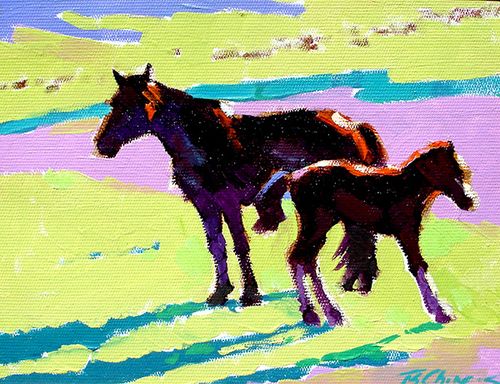
Colt (2006) is a masterful early work by the Mongolian artist Chinggis Tulgabaatar, executed when the artist was just 21 years old. Despite its modest dimensions (23 x 28 cm), the painting captures the expansive spirit of the Mongolian steppe through a tight, intimate focus on its subject.
Visual Composition and Style
Tulgabaatar employs a sophisticated blend of Photorealism and Realism to bring this young horse to life. The composition is likely a close-up portrait, focusing on the textures and physiological nuances of the foal:
Texture and Detail: Utilizing oil on canvas, the artist meticulously renders the soft, downy coat of the colt. You can almost feel the transition between the coarser mane and the velvet-like texture of the muzzle.
The Gaze: As a piece of Portrait and Figurative Art, the work likely centers on the “expression” of the animal—capturing the curiosity, vulnerability, and inherent wildness typical of a young horse.
Lighting: Tulgabaatar often uses naturalistic lighting to define form. In Colt, the light likely skims the contours of the animal’s muscles and skeletal structure, providing a three-dimensional depth that belies the small scale of the canvas.
Thematic Context
Born in Ulaanbaatar, Tulgabaatar’s work is deeply rooted in the cultural identity of Mongolia, where the horse is a symbol of freedom, heritage, and survival.
Nature and Landscape: While the focus is the animal, the background likely hints at the vast Mongolian landscape—perhaps through a soft-focus (bokeh) effect that emphasizes the Photorealist precision of the foreground.
Youth and Potential: Painted in 2006, the choice of a “colt” (a young male horse) serves as a metaphor for growth and the burgeoning power of the natural world.
Technical Mastery
The small size of the painting suggests a “cabinet painting” style, intended for close inspection. Tulgabaatar’s ability to maintain anatomical accuracy while infused with the soulful quality of Realism marks him as a significant voice in contemporary Mongolian art. His brushwork is disciplined, hiding the hand of the artist to let the subject—the colt—speak for itself.
Note: This piece represents a pivotal moment in Tulgabaatar’s career, showcasing the technical foundation that would later allow him to explore more complex figurative and nature-based themes.