Ger District

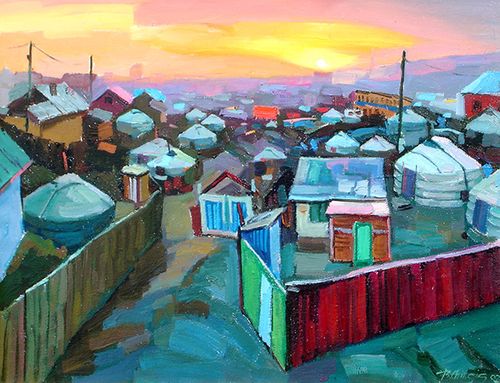
Chinggis Tulgabaatar , 2006 , Oil On Canvas

Ger District is a compelling 2006 oil-on-canvas painting by the Mongolian contemporary artist Chinggis Tulgabaatar. Measuring $30 \times 40\text{cm}$, the work is a concentrated exploration of Ulaanbaatar’s unique urban landscape, blending the artist’s mastery of Photorealism with a deep, Figurative sensitivity.

Composition and Visual Narrative

The painting captures a scene from a “Ger district”—the sprawling residential areas on the outskirts of Ulaanbaatar where traditional nomadic dwellings (gers) coexist with permanent wooden or brick structures.

  • Subject Matter: The piece likely features the stark contrast of white, circular gers against the angularity of wooden fences (khashaas) and the rugged, rolling hills of the Mongolian landscape. Tulgabaatar’s focus is not just on the architecture, but on the atmosphere of the space—the way the high-altitude light interacts with the textures of felt, wood, and earth.

  • Technique (Photorealism & Realism): Given Tulgabaatar’s style, the painting is characterized by its meticulous attention to detail. Every knot in a wooden fence and every subtle shadow on the ger’s canvas is rendered with clinical precision, making the scene feel immediate and tangible.

  • Color Palette: The artist often utilizes a muted, earthy palette—ochres, dusty browns, and brilliant sky blues—to reflect the natural environment of Mongolia. The white of the gers serves as a central focal point, symbolizing the persistence of nomadic identity within a modernizing urban setting.

Artistic Context and Style

Tulgabaatar, born in 1985 in Ulaanbaatar, belongs to a generation of Mongolian artists who bridge the gap between traditional heritage and global contemporary styles.

  • The Intersection of Nature and City: Though labeled as a Landscape, “Ger District” functions as a socio-cultural portrait of a city in transition. It captures the “lived-in” reality of the suburbs, moving beyond the idealized depictions of the steppe to show the intersection of human habitation and the natural world.

  • Figurative Depth: Even if human figures are not prominently featured, the painting is intensely Figurative in spirit. It documents the “fingerprints” of human life—smoke rising from chimneys, laundry on a line, or the trodden paths between homes—giving the viewer an intimate look at the daily existence of the Ulaanbaatar residents.

Significance of the Work

Created when the artist was just 21, this work showcases Tulgabaatar’s early technical prowess and his commitment to documenting his surroundings with honesty. It stands as a testament to the enduring presence of the ger as a symbol of Mongolian resilience and cultural continuity amidst the rapid urbanization of the 21st century.
  • Chinggis Tulgabaatar
  • Landscape, Mongolian Style
  • Oil On Canvas
  • CHI72/002
  • 30 x 40cm
  • Mongolian Art Gallery

Add Your Comment

Mongolian Art Gallery © 2025. All Rights Reserved
Privacy Policy / Terms of Use

Ger District is a compelling 2006 oil-on-canvas painting by the Mongolian contemporary artist Chinggis Tulgabaatar. Measuring $30 \times 40\text{cm}$, the work is a concentrated exploration of Ulaanbaatar’s unique urban landscape, blending the artist’s mastery of Photorealism with a deep, Figurative sensitivity.

Composition and Visual Narrative

The painting captures a scene from a “Ger district”—the sprawling residential areas on the outskirts of Ulaanbaatar where traditional nomadic dwellings (gers) coexist with permanent wooden or brick structures.

  • Subject Matter: The piece likely features the stark contrast of white, circular gers against the angularity of wooden fences (khashaas) and the rugged, rolling hills of the Mongolian landscape. Tulgabaatar’s focus is not just on the architecture, but on the atmosphere of the space—the way the high-altitude light interacts with the textures of felt, wood, and earth.

  • Technique (Photorealism & Realism): Given Tulgabaatar’s style, the painting is characterized by its meticulous attention to detail. Every knot in a wooden fence and every subtle shadow on the ger’s canvas is rendered with clinical precision, making the scene feel immediate and tangible.

  • Color Palette: The artist often utilizes a muted, earthy palette—ochres, dusty browns, and brilliant sky blues—to reflect the natural environment of Mongolia. The white of the gers serves as a central focal point, symbolizing the persistence of nomadic identity within a modernizing urban setting.

Artistic Context and Style

Tulgabaatar, born in 1985 in Ulaanbaatar, belongs to a generation of Mongolian artists who bridge the gap between traditional heritage and global contemporary styles.

  • The Intersection of Nature and City: Though labeled as a Landscape, “Ger District” functions as a socio-cultural portrait of a city in transition. It captures the “lived-in” reality of the suburbs, moving beyond the idealized depictions of the steppe to show the intersection of human habitation and the natural world.

  • Figurative Depth: Even if human figures are not prominently featured, the painting is intensely Figurative in spirit. It documents the “fingerprints” of human life—smoke rising from chimneys, laundry on a line, or the trodden paths between homes—giving the viewer an intimate look at the daily existence of the Ulaanbaatar residents.

Significance of the Work

Created when the artist was just 21, this work showcases Tulgabaatar’s early technical prowess and his commitment to documenting his surroundings with honesty. It stands as a testament to the enduring presence of the ger as a symbol of Mongolian resilience and cultural continuity amidst the rapid urbanization of the 21st century.