
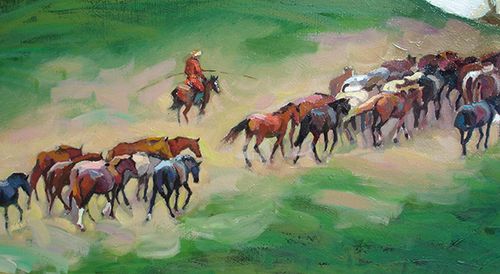
Horse In The Steppe (2006) is a evocative oil-on-canvas work by Mongolian artist Chinggis Tulgabaatar. Measuring 25 x 60 cm, the painting utilizes an elongated horizontal panoramic format that mirrors the vast, unbroken horizons of the Central Asian plateau. Created when the artist was just 21 years old, the piece serves as a sophisticated bridge between classical Mongolian pastoral themes and the meticulous precision of contemporary photorealism.
Visual Composition and Subject Matter
The painting features a singular, powerful horse as its focal point, set against the rhythmic backdrop of the Mongolian steppe. Tulgabaatar employs a Rule of Thirds composition, placing the horse slightly off-center to create a sense of movement and “breathable” space within the wide frame.
The Subject: The horse is rendered with Photorealistic detail. Every muscle fiber, the velvet texture of the coat, and the fine hairs of the mane are articulated with microscopic precision. The artist captures the animal in a moment of quiet alertness, its head turned slightly as if catching a scent or sound on the wind.
The Landscape: The “Steppe” is not merely a background but a living character. The lower half of the canvas is a rich tapestry of scorched ambers, olive greens, and dusty ochres, representing the hardy vegetation of the plains. The horizon line is placed low, allowing a vast, atmospheric sky to dominate the upper portion, emphasizing the isolation and grandeur of the environment.
Style and Technique
Tulgabaatar’s approach is a masterclass in Realism and Figurative Art, characterized by:
Luminous Depth: Through the patient layering of oil glazes, the artist achieves a glow that suggests the “Golden Hour”—that specific moment before sunset when the light is low and directional.
Textural Contrast: There is a deliberate contrast between the sharp, crisp rendering of the horse (the “Portrait” element) and the softer, more impressionistic blending of the distant hills and sky. This creates a naturalistic depth of field.
Anatomical Accuracy: Reflecting his heritage and keen observation, Tulgabaatar portrays the horse with perfect anatomical proportions, conveying both its physical strength and its inherent grace.
Thematic Significance
While the painting is a triumph of Nature and Landscape art, it also functions as a cultural portrait. The horse is the soul of Mongolian identity, symbolizing freedom, endurance, and the nomadic spirit. By isolating the animal in such a wide, empty space, Tulgabaatar evokes a sense of profound solitude and the eternal relationship between the inhabitant and the land.
Artist Profile: Born in 1985 in Ulaanbaatar, Chinggis Tulgabaatar represents a generation of Mongolian artists who have mastered Western technical realism while remaining deeply rooted in the iconography of their homeland.