My Father

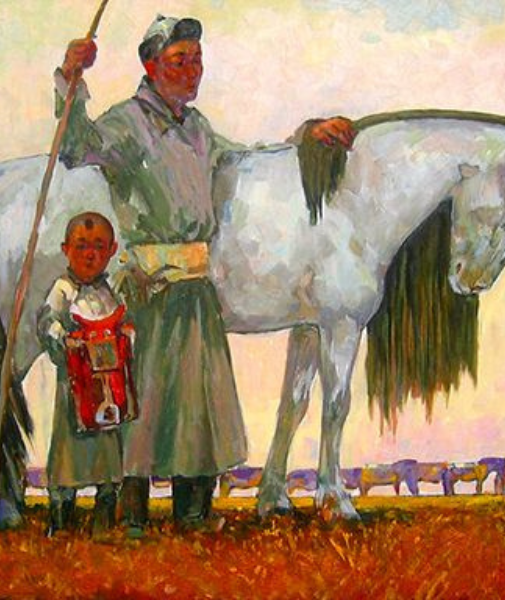
Bayarbaatar Selee , 2004 , Oil On Canvas

In the deeply resonant and emotionally stirring My Father, Bayarbaatar Selee captures the profound essence of paternal heritage through a lens of intimate, painterly realism. Measuring 59 x 79 cm (23″ x 31″), this 2005 oil on canvas utilizes a masterful horizontal composition to ground the subject in a space that feels both personal and universal. The unique selling point of this portrait is Selee’s exceptional ability to convey internal life through external texture; by layering rich, earthy impasto to delineate the weathered contours of the face and hands, he creates a topographical landscape of experience. This sculptural application of pigment, contrasted against a soft, atmospheric background, gives the subject a hauntingly present, lifelike quality that commands the viewer’s empathy. Unlike a standard portrait, this work is a meditative dialogue on the weight of time, the resilience of the human spirit, and the quiet pride of a life well-lived. For the discerning collector, My Father is a premium, high-impact acquisition—a sophisticated and deeply felt focal point that brings an aura of authenticity, history, and gravitas to any refined collection.

About the Artist

Born in 1964 in Ulaanbaatar, Mongolia, Bayarbaatar Selee is an acclaimed contemporary artist renowned for his ability to translate the raw, austere beauty of the Mongolian landscape and the authentic rhythms of daily life into deeply resonant, high-impact figurative works. His practice is characterized by a sophisticated, nuanced approach to light and composition, often focusing on themes of heritage, resilience, and the intimate connections between people and their environment. With a career spanning decades, Selee has earned significant recognition for his evocative, painterly style, which bridges the gap between traditional realism and contemporary emotional storytelling, securing his place as a vital, enduring voice in modern Central Asian art.
  • Bayarbaatar Selee
  • Early 21st Century
  • Ulaanbaatar, Mongolia
  • Figurative, Landscape, Modern/Contemporary, Nature, Realism
  • Oil on canvas
  • BYR10/003
  • 59 x 79cm23" x 31"
  • Mongolian Art Gallery

Add Your Comment

Mongolian Art Gallery © 2025. All Rights Reserved
Privacy Policy / Terms of Use

In the deeply resonant and emotionally stirring My Father, Bayarbaatar Selee captures the profound essence of paternal heritage through a lens of intimate, painterly realism. Measuring 59 x 79 cm (23″ x 31″), this 2005 oil on canvas utilizes a masterful horizontal composition to ground the subject in a space that feels both personal and universal. The unique selling point of this portrait is Selee’s exceptional ability to convey internal life through external texture; by layering rich, earthy impasto to delineate the weathered contours of the face and hands, he creates a topographical landscape of experience. This sculptural application of pigment, contrasted against a soft, atmospheric background, gives the subject a hauntingly present, lifelike quality that commands the viewer’s empathy. Unlike a standard portrait, this work is a meditative dialogue on the weight of time, the resilience of the human spirit, and the quiet pride of a life well-lived. For the discerning collector, My Father is a premium, high-impact acquisition—a sophisticated and deeply felt focal point that brings an aura of authenticity, history, and gravitas to any refined collection.

About the Artist

Born in 1964 in Ulaanbaatar, Mongolia, Bayarbaatar Selee is an acclaimed contemporary artist renowned for his ability to translate the raw, austere beauty of the Mongolian landscape and the authentic rhythms of daily life into deeply resonant, high-impact figurative works. His practice is characterized by a sophisticated, nuanced approach to light and composition, often focusing on themes of heritage, resilience, and the intimate connections between people and their environment. With a career spanning decades, Selee has earned significant recognition for his evocative, painterly style, which bridges the gap between traditional realism and contemporary emotional storytelling, securing his place as a vital, enduring voice in modern Central Asian art.