Temuujin

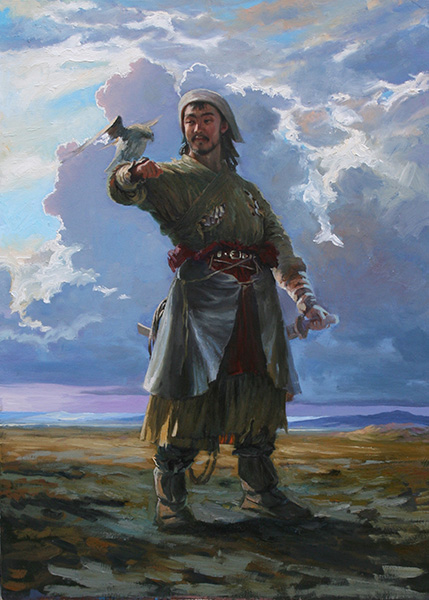
Batjargal Tseintsogzol , 2008 , Oil On Canvas

The painting Temuujin (2008) by the late Mongolian master Batjargal Tseintsogzol is a masterclass in photorealistic portraiture, capturing the foundational spirit of the boy who would eventually become Genghis Khan.

Measuring 50 x 70 cm, this oil on canvas serves as both a historical reimagining and a profound psychological study.

Visual Composition and Style

Tseintsogzol, known for his meticulous Photorealism, employs a tight, medium-close-up composition. The young Temuujin is the singular focus, rendered with such precision that every texture—from the individual fibers of his fur-lined deel (traditional Mongolian tunic) to the subtle moisture in his eyes—feels tangible.

  • The Subject: Temuujin is depicted not as a legendary conqueror, but as a youth of the steppe. His expression is a complex blend of stoicism, alertness, and a quiet, simmering intensity.

  • Lighting: The artist uses a naturalistic light source, likely mimicking the harsh, bright sun of the Mongolian plateau. This creates deep, soft shadows that define the bone structure of the boy’s face, highlighting his high cheekbones and determined jawline.

  • Color Palette: The palette is dominated by earthy, organic tones—burnt umbers, deep ochres, and the rich, textured browns of leather and fur. These colors ground the subject in the natural world, reflecting Tseintsogzol’s deep association with Realism and Nature.

Symbolic Elements

While the style is rooted in realism, the painting carries significant weight through its details:

  • The Gaze: Temuujin looks slightly off-camera, his eyes fixed on a distant horizon. It suggests a boy burdened with a vision or a destiny far beyond his years.

  • The Attire: The ruggedness of his clothing speaks to the harsh environment of the 12th-century steppe. The detailed rendering of the fur collar emphasizes the necessity of survival and the close bond between the nomadic people and their livestock.

About the Artist: Batjargal Tseintsogzol (1966–2020)

Tseintsogzol was a towering figure in contemporary Mongolian art. Born in Ulaanbaatar, he dedicated his career to capturing the soul of Mongolia—its landscapes, its people, and its history. His work is characterized by a “hyper-aware” quality, where the technical perfection of photorealism is used to elevate the subject’s dignity. Temuujin stands as one of his most evocative works, bridging the gap between Mongolia’s nomadic past and its modern artistic identity.
  • Batjargal Tseintsogzol
  • Realism, Still Life
  • Oil On Canvas
  • BTJ8/110
  • 50 x 70cm

Add Your Comment

Mongolian Art Gallery © 2025. All Rights Reserved
Privacy Policy / Terms of Use

The painting Temuujin (2008) by the late Mongolian master Batjargal Tseintsogzol is a masterclass in photorealistic portraiture, capturing the foundational spirit of the boy who would eventually become Genghis Khan.

Measuring 50 x 70 cm, this oil on canvas serves as both a historical reimagining and a profound psychological study.

Visual Composition and Style

Tseintsogzol, known for his meticulous Photorealism, employs a tight, medium-close-up composition. The young Temuujin is the singular focus, rendered with such precision that every texture—from the individual fibers of his fur-lined deel (traditional Mongolian tunic) to the subtle moisture in his eyes—feels tangible.

  • The Subject: Temuujin is depicted not as a legendary conqueror, but as a youth of the steppe. His expression is a complex blend of stoicism, alertness, and a quiet, simmering intensity.

  • Lighting: The artist uses a naturalistic light source, likely mimicking the harsh, bright sun of the Mongolian plateau. This creates deep, soft shadows that define the bone structure of the boy’s face, highlighting his high cheekbones and determined jawline.

  • Color Palette: The palette is dominated by earthy, organic tones—burnt umbers, deep ochres, and the rich, textured browns of leather and fur. These colors ground the subject in the natural world, reflecting Tseintsogzol’s deep association with Realism and Nature.

Symbolic Elements

While the style is rooted in realism, the painting carries significant weight through its details:

  • The Gaze: Temuujin looks slightly off-camera, his eyes fixed on a distant horizon. It suggests a boy burdened with a vision or a destiny far beyond his years.

  • The Attire: The ruggedness of his clothing speaks to the harsh environment of the 12th-century steppe. The detailed rendering of the fur collar emphasizes the necessity of survival and the close bond between the nomadic people and their livestock.

About the Artist: Batjargal Tseintsogzol (1966–2020)

Tseintsogzol was a towering figure in contemporary Mongolian art. Born in Ulaanbaatar, he dedicated his career to capturing the soul of Mongolia—its landscapes, its people, and its history. His work is characterized by a “hyper-aware” quality, where the technical perfection of photorealism is used to elevate the subject’s dignity. Temuujin stands as one of his most evocative works, bridging the gap between Mongolia’s nomadic past and its modern artistic identity.