

1. The Central Subject: The Hunter and His Eagle
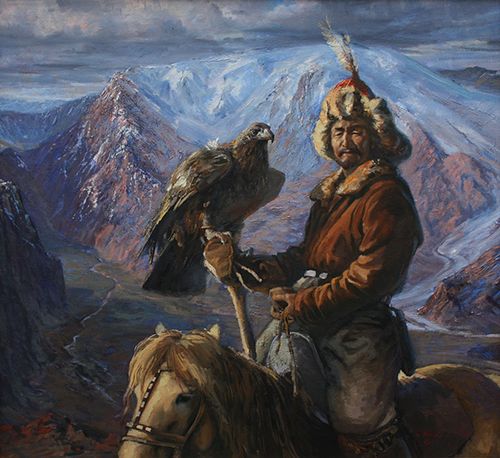
The composition is dominated by a Kazakh eagle hunter (Burkitshi) in traditional attire. Tseintsogzol’s precision is evident in the textures of the hunter’s degl (traditional robe) and the thick, weathered fur of his hat.
The relationship between the man and the Golden Eagle is the emotional core of the piece. The eagle, perched firmly on the hunter’s gloved arm, is rendered with such detail that individual barbs on the feathers and the sharp, glassy reflection in its eye are visible. This highlights the “Extended” nature of the title—the bird is not just a tool, but an extension of the hunter’s own soul and survival.
2. Atmosphere and Light
Tseintsogzol utilizes a crisp, cold palette that reflects the high-altitude environment of Western Mongolia.
Light: The light source appears natural and sharp, characteristic of the Mongolian sun reflecting off snow and rocky terrain.
Contrast: There is a stark contrast between the warm, organic browns of the eagle’s plumage and the hunter’s gear against the cool, sweeping expanse of the background.
3. Landscape and Perspective
True to the Nature style associated with the artist, the background is not merely a backdrop but a character itself.
Depth: The artist employs atmospheric perspective, where the distant, snow-capped peaks of the Altai range fade into soft blues and whites.
Texture: The foreground often features the tactile reality of the Mongolian steppe—cracked earth, sparse winter grass, or the fine powder of fresh snow.
Style and Significance
As a leading figure in Mongolian contemporary art, Batjargal Tseintsogzol (1966–2020) was celebrated for his ability to bridge the gap between technical perfection and cultural heritage.
Photorealism: The painting challenges the viewer to distinguish it from a high-resolution photograph. Every stitch in the leather harness and every wrinkle on the hunter’s face is accounted for.
Cultural Preservation: By focusing on the Eagle Hunters, Tseintsogzol documents a 6,000-year-old tradition that is increasingly threatened by modernization. The “Extended” canvas size allows for a more cinematic, immersive experience of this vast nomadic lifestyle.
