
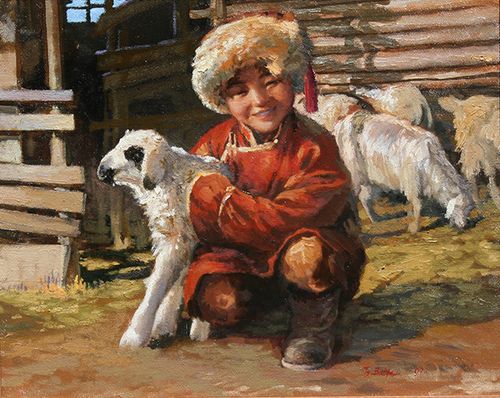
At its core, Childhood is an intimate study of innocence set against the vast, unforgiving beauty of the Mongolian steppe.
The Subject: The painting features a young child, likely a nomadic herder’s offspring, dressed in traditional Mongolian attire. The child’s face is rendered with breathtaking precision—every sun-kissed freckle, the slight chapping of the lips from the high-altitude wind, and the profound, liquid clarity of the eyes are visible.
The Focal Point: Tseintsogzol focuses heavily on the child’s expression. There is a sense of “quiet presence”—a hallmark of his work—where the child isn’t just a subject but a witness to the environment.
The Background: While the child is the primary focus, the background features the soft-focus expanse of the plains. The 40 x 50cm canvas size forces a tight, portrait-like intimacy, making the vastness of Mongolia feel personal rather than distant.
Style and Technique
Tseintsogzol was a leading figure in Mongolian Photorealism, and Childhood is a prime example of his technical prowess.
Oil on Canvas: The choice of oil allows for the rich, layered textures seen in the child’s skin and the heavy wool or silk of their clothing. The blending is seamless, eliminating visible brushstrokes to mimic the clarity of a high-resolution photograph.
Lighting: The lighting is naturalistic, suggesting the “golden hour” of a Mongolian afternoon. It casts a warm, soft glow that highlights the contours of the face while leaving the background in a gentle, atmospheric haze (sfumato).
Nature & Realism: True to his style, Tseintsogzol doesn’t romanticize or “clean up” the scene. He captures the grit, the dust, and the raw reality of life on the steppe, which paradoxically makes the beauty of the “childhood” theme even more poignant.
Emotional Resonance
The painting serves as a bridge between the old world and the new. Created in 2009, it captures a way of life that is increasingly challenged by urbanization.
Nostalgia: The title, Childhood, evokes a universal feeling, yet the specific cultural markers (the clothing, the facial structure, the light) ground it firmly in Mongolian identity.
Quietude: There is a stillness in the work. It reflects Tseintsogzol’s own deep connection to his birthplace, Ulaanbaatar, and the surrounding wilderness, portraying a child who is perfectly at home in the silence of nature.
Artist Profile: Batjargal Tseintsogzol (1966–2020)
Tseintsogzol’s legacy is defined by his ability to elevate everyday Mongolian life to the level of high art. His untimely passing in 2020 was a significant loss to the Central Asian art community, but works like Childhood remain as definitive benchmarks of contemporary Mongolian realism.