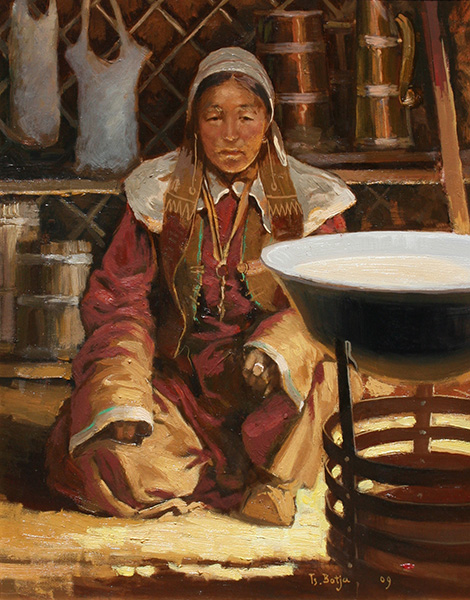
Old Woman

Batjargal Tseintsogzol , 2009 , Oil On Canvas

The painting “Old Woman” (2009) by the Mongolian artist Batjargal Tseintsogzol is a masterclass in contemporary photorealism, capturing not just a likeness, but the weight of a lifetime. Tseintsogzol, known for his precision and deep connection to the Mongolian soul, uses this 40 x 50cm oil on canvas to bridge the gap between technical perfection and raw human emotion.

Visual Composition and Style

The work is executed in a strict Photorealistic style, where every detail is rendered with such clarity that it mimics the depth of field found in high-end portrait photography.

  • The Subject: The focus is entirely on the elderly woman’s face, which serves as a map of her experiences. Tseintsogzol doesn’t shy away from the “imperfections” of age; instead, he celebrates them.

  • Texture and Detail: The artist meticulously renders the “crows feet” around the eyes, the deep furrows of the brow, and the papery texture of the skin. There is a palpable sense of the underlying bone structure, suggesting both fragility and a weathered resilience.

  • Color Palette: Typically following the Earth-toned palette of the Mongolian steppe, the painting likely uses warm ochres, deep umbers, and soft greys. This choice anchors the subject to the natural world, reflecting Tseintsogzol’s association with Nature and Realism.

Symbolism and Cultural Context

Batjargal Tseintsogzol’s work often reflects the transition of Mongolia from a nomadic tradition to a modern state. This portrait acts as a silent witness to that history.

  • The Gaze: The woman’s eyes are often the focal point—clouded perhaps by age but sharp with wisdom. Her expression isn’t one of sorrow, but of a quiet, stoic “knowing” that is characteristic of the elder generation in Mongolian culture.

  • Light and Shadow: The use of chiaroscuro (the contrast between light and dark) creates a dramatic intensity. The light usually falls from one side, highlighting the ridges of her wrinkles and casting the other side into soft shadow, symbolizing the duality of life and the approach of the twilight years.
  • Batjargal Tseintsogzol
  • Mongolian Style, Nature, Photorealism
  • Oil On Canvas
  • BTJ8/104
  • 40 x 50cm
  • Mongolian Art Gallery

Add Your Comment

Mongolian Art Gallery © 2025. All Rights Reserved
Privacy Policy / Terms of Use

The painting “Old Woman” (2009) by the Mongolian artist Batjargal Tseintsogzol is a masterclass in contemporary photorealism, capturing not just a likeness, but the weight of a lifetime. Tseintsogzol, known for his precision and deep connection to the Mongolian soul, uses this 40 x 50cm oil on canvas to bridge the gap between technical perfection and raw human emotion.

Visual Composition and Style

The work is executed in a strict Photorealistic style, where every detail is rendered with such clarity that it mimics the depth of field found in high-end portrait photography.

  • The Subject: The focus is entirely on the elderly woman’s face, which serves as a map of her experiences. Tseintsogzol doesn’t shy away from the “imperfections” of age; instead, he celebrates them.

  • Texture and Detail: The artist meticulously renders the “crows feet” around the eyes, the deep furrows of the brow, and the papery texture of the skin. There is a palpable sense of the underlying bone structure, suggesting both fragility and a weathered resilience.

  • Color Palette: Typically following the Earth-toned palette of the Mongolian steppe, the painting likely uses warm ochres, deep umbers, and soft greys. This choice anchors the subject to the natural world, reflecting Tseintsogzol’s association with Nature and Realism.

Symbolism and Cultural Context

Batjargal Tseintsogzol’s work often reflects the transition of Mongolia from a nomadic tradition to a modern state. This portrait acts as a silent witness to that history.

  • The Gaze: The woman’s eyes are often the focal point—clouded perhaps by age but sharp with wisdom. Her expression isn’t one of sorrow, but of a quiet, stoic “knowing” that is characteristic of the elder generation in Mongolian culture.

  • Light and Shadow: The use of chiaroscuro (the contrast between light and dark) creates a dramatic intensity. The light usually falls from one side, highlighting the ridges of her wrinkles and casting the other side into soft shadow, symbolizing the duality of life and the approach of the twilight years.