
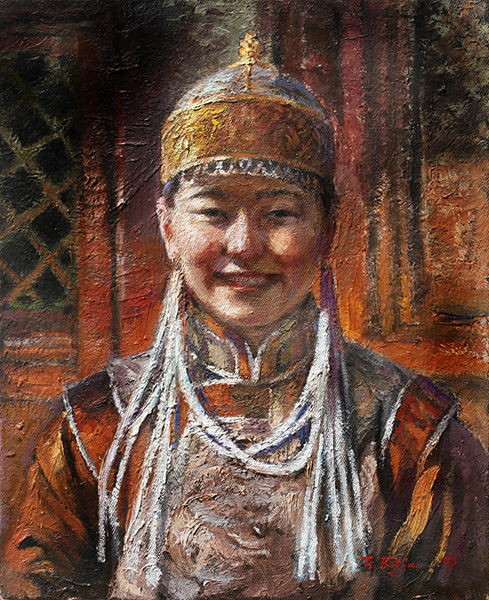
This 2009 oil on canvas is a compelling example of the late Mongolian artist Batjargal Tseintsogzol’s mastery of Photorealism. Measuring 45 x 35 cm, the work is an intimate, medium-shot portrait that bridges the gap between technical precision and deep psychological resonance.
Visual Breakdown
Subject and Composition: The painting features a woman, likely Mongolian, rendered with such meticulous detail that it mimics the depth of field found in high-resolution photography. The composition is tight, focusing heavily on the subject’s facial features and the play of light across her skin.
Technique (Photorealism & Realism): Tseintsogzol utilizes incredibly fine brushwork to capture the nuances of human anatomy. Every pore, the slight moisture on the lips, and the intricate reflections in the eyes are handled with a clinical yet soulful accuracy.
Color Palette: The palette is grounded in earthy, naturalistic tones. Expect a sophisticated play of warm ochres, deep umbers, and delicate fleshy pinks. The background is likely muted or softly out of focus—a classic “bokeh” effect translated to paint—to ensure the viewer’s undivided attention remains on the sitter.
Lighting: The light source is typically soft and directional, creating subtle transitions between light and shadow (chiaroscuro) that give the face a three-dimensional, sculptural quality.
Context and Artist Style
Born in Ulaanbaatar, Tseintsogzol was a prominent figure in Mongolian contemporary art, known for his ability to weave Nature and Humanity together. While this piece is a “Woman Portrait,” his work often carries an underlying connection to the Mongolian landscape—whether through the rugged texture of the skin or the quiet, stoic expressions of his subjects.
Note on Style: In the context of Mongolian art, Tseintsogzol’s move toward high realism in 2009 represented a sophisticated evolution, moving away from traditional folk styles toward a globalized, modern aesthetic while retaining a distinctly local soul.