
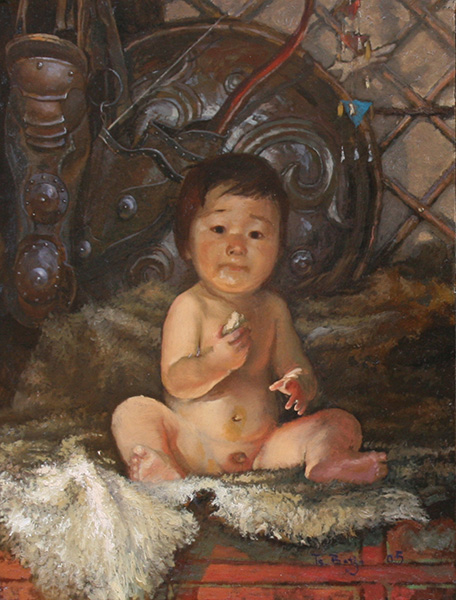
Tseintsogzol was a titan of Photorealism in Mongolia, and Baby serves as a masterclass in his ability to capture the “soul” of a subject through hyper-accurate detail. At 30 x 40 cm, the painting is intimate—roughly the size of a standard laptop—which forces the viewer to lean in and engage with the subject on a personal level.
1. Composition and Subject
The painting features a close-up study of an infant. In keeping with Tseintsogzol’s Realism roots, the artist does not romanticize or “soften” the features into a generic cherub. Instead, he captures the specific, tactile reality of Mongolian infancy. The tight framing focuses on the softness of the skin, the moisture in the eyes, and the delicate texture of the hair.
2. Light and Texture
The mastery of oil paint is evident in how Tseintsogzol handles luminosity.
The Skin: He uses thin, glazed layers of oil to recreate the translucent quality of a baby’s skin, showing the subtle warmth of blood vessels beneath the surface.
The Eyes: A hallmark of his style is the “wet” look of the eyes, achieved through precise white specular highlights that give the subject a living, breathing presence.
Nature Influence: Even in a portrait, his “Nature” style is present through the organic, unforced pose and the use of a natural, earthy color palette that avoids synthetic or overly bright tones.
3. The Photorealistic Approach
While many artists use photorealism to create a cold, mechanical copy, Tseintsogzol’s work in 2008 was deeply humanistic. Every wrinkle in the clothing or stray strand of hair is rendered with a devotion that elevates the mundane into the monumental.
Cultural Context
As an artist born and raised in Ulaanbaatar, Tseintsogzol often bridged the gap between traditional Mongolian life and modern academic precision. Baby represents the future and the continuity of life—a theme often explored in Mongolian art through the lens of family and the “cradle” of the nomadic spirit.
The year 2008 marked a period where his technical skill was at its peak, blending the rigorous training of the Mongolian University of Arts and Culture with a contemporary global aesthetic.
Note: Tseintsogzol’s legacy remains a cornerstone of Mongolian contemporary realism, characterized by a profound silence and dignity in his subjects.