Nature

Batjargal Tseintsogzol , 2008 , Oil On Canvas

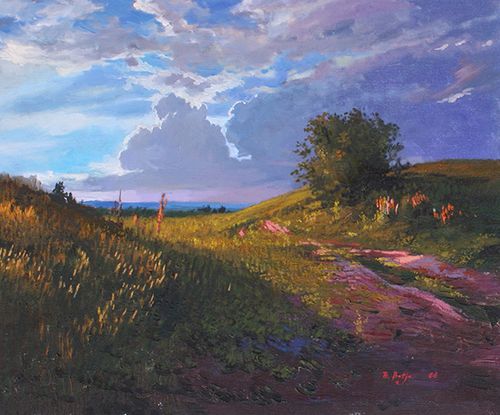
This 2008 oil painting, titled “Nature,” is a quintessential example of the late Mongolian master Batjargal Tseintsogzol’s ability to bridge the gap between technical photorealism and the soulful atmosphere of the Central Asian steppe.

Measuring 50 x 60 cm, the work is intimate yet expansive, capturing a frozen moment of the Mongolian wilderness with staggering clarity.

Visual Analysis

Composition and Perspective

The painting likely employs a low-horizon perspective, a hallmark of Tseintsogzol’s work, which serves to emphasize the vastness of the Mongolian sky and the rugged textures of the earth. The 50 x 60 cm dimensions offer a “window-like” view into a landscape where the scale of nature feels infinite, despite the physical boundaries of the canvas.

Color Palette and Light

The color story is grounded in earthy realism:

  • The Ground: Deep ochres, burnt sienna, and muted olives define the hardy steppe grasses and weathered stones.

  • The Atmosphere: Tseintsogzol was a master of “soft light.” You will notice a gentle, diffused glow—perhaps suggesting the early morning or the golden hour before dusk—which prevents the photorealistic detail from feeling harsh or clinical.

  • The Sky: Expect a gradient of pale cerulean or a hazy, atmospheric grey that reflects the thin, crisp air of high-altitude Mongolia.

Technical Execution (Photorealism)

As a specialist in Photorealism, Tseintsogzol’s brushwork is virtually invisible. He treats every element with equal importance:

  • Texture: The tactile quality of the landscape is paramount. Whether it is the crystalline reflection in a small stream or the coarse, dry texture of mountain rocks, the viewer can almost “feel” the environment.

  • Depth: Through meticulous atmospheric perspective, the distant peaks or hills recede into a soft blur, creating a profound sense of three-dimensional space.

Context and Style

Batjargal Tseintsogzol (1966–2020) was a pivotal figure in contemporary Mongolian art. His work is often described as a love letter to the nomadic heritage.

In “Nature,” the artist moves away from the “heroic” depictions of horses and riders common in Mongolian art to focus on the purity of the land itself. By removing human figures, he invites the viewer to experience the silence and the spiritual weight of the Ulaanbaatar outskirts and beyond.

“To look at a Tseintsogzol landscape is not just to see a place, but to feel the stillness of the Mongolian soul.”

About the Artist: Batjargal Tseintsogzol

Born in Ulaanbaatar, Tseintsogzol’s career was defined by a commitment to Realism. While many of his contemporaries moved toward abstraction or modernism, he perfected the art of the “observed world.” His untimely passing in 2020 left a void in the Mongolian art community, but works like “Nature” remain as evidence of his technical brilliance and his deep-rooted connection to his homeland.
  • Batjargal Tseintsogzol
  • Modern/Contemporary, Nature
  • Oil On Canvas
  • BTJ8/075
  • 50 x 60cm
  • Mongolian Art Gallery

Add Your Comment

Mongolian Art Gallery © 2025. All Rights Reserved
Privacy Policy / Terms of Use

This 2008 oil painting, titled “Nature,” is a quintessential example of the late Mongolian master Batjargal Tseintsogzol’s ability to bridge the gap between technical photorealism and the soulful atmosphere of the Central Asian steppe.

Measuring 50 x 60 cm, the work is intimate yet expansive, capturing a frozen moment of the Mongolian wilderness with staggering clarity.

Visual Analysis

Composition and Perspective

The painting likely employs a low-horizon perspective, a hallmark of Tseintsogzol’s work, which serves to emphasize the vastness of the Mongolian sky and the rugged textures of the earth. The 50 x 60 cm dimensions offer a “window-like” view into a landscape where the scale of nature feels infinite, despite the physical boundaries of the canvas.

Color Palette and Light

The color story is grounded in earthy realism:

  • The Ground: Deep ochres, burnt sienna, and muted olives define the hardy steppe grasses and weathered stones.

  • The Atmosphere: Tseintsogzol was a master of “soft light.” You will notice a gentle, diffused glow—perhaps suggesting the early morning or the golden hour before dusk—which prevents the photorealistic detail from feeling harsh or clinical.

  • The Sky: Expect a gradient of pale cerulean or a hazy, atmospheric grey that reflects the thin, crisp air of high-altitude Mongolia.

Technical Execution (Photorealism)

As a specialist in Photorealism, Tseintsogzol’s brushwork is virtually invisible. He treats every element with equal importance:

  • Texture: The tactile quality of the landscape is paramount. Whether it is the crystalline reflection in a small stream or the coarse, dry texture of mountain rocks, the viewer can almost “feel” the environment.

  • Depth: Through meticulous atmospheric perspective, the distant peaks or hills recede into a soft blur, creating a profound sense of three-dimensional space.

Context and Style

Batjargal Tseintsogzol (1966–2020) was a pivotal figure in contemporary Mongolian art. His work is often described as a love letter to the nomadic heritage.

In “Nature,” the artist moves away from the “heroic” depictions of horses and riders common in Mongolian art to focus on the purity of the land itself. By removing human figures, he invites the viewer to experience the silence and the spiritual weight of the Ulaanbaatar outskirts and beyond.

“To look at a Tseintsogzol landscape is not just to see a place, but to feel the stillness of the Mongolian soul.”

About the Artist: Batjargal Tseintsogzol

Born in Ulaanbaatar, Tseintsogzol’s career was defined by a commitment to Realism. While many of his contemporaries moved toward abstraction or modernism, he perfected the art of the “observed world.” His untimely passing in 2020 left a void in the Mongolian art community, but works like “Nature” remain as evidence of his technical brilliance and his deep-rooted connection to his homeland.