
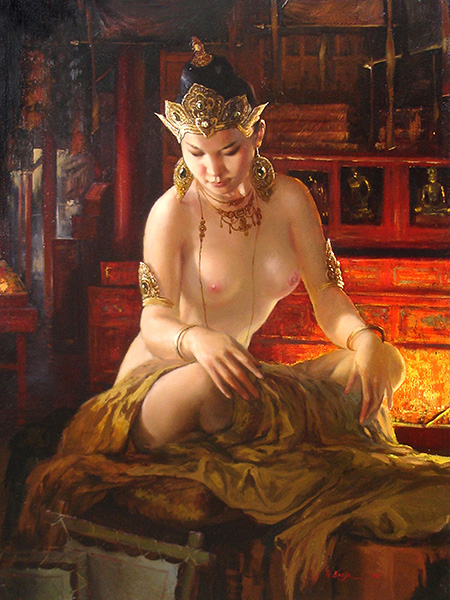
In The Studio is a captivating example of Batjargal Tseintsogzol’s mastery of photorealism and his ability to elevate the mundane into the monumental. Painted in 2008, this oil-on-canvas work (83 x 63 cm) serves as a profound meditation on the artist’s environment, capturing a quiet, frozen moment within the sanctuary of a creative workspace.
Composition and Style
The painting reflects Tseintsogzol’s signature blend of Realism and meticulous attention to detail. Rather than a wide-angle view of a bustling atelier, the artist chooses a focused, intimate composition. The 83 x 63 cm dimensions create a “window-like” effect, drawing the viewer into a space that feels both personal and universal.
Photorealistic Precision: Every texture—from the grain of wooden surfaces to the reflective sheen on glass jars or metallic tools—is rendered with such technical accuracy that the boundary between paint and reality blurs.
Chiaroscuro Influence: Tseintsogzol utilizes a sophisticated play of light and shadow. The light source often feels singular and directional, reminiscent of Old Master techniques, casting deep shadows that give the objects a sculptural, three-dimensional presence.
Themes and Atmosphere
Born and raised in Ulaanbaatar, Tseintsogzol’s work often bridges the gap between traditional Mongolian sensibilities and contemporary global techniques. In this piece:
The Beauty of Utility: By focusing on the tools of the trade—brushes, palettes, or perhaps half-finished canvases—the artist pays homage to the labor of creation. The “Nature” aspect of his style is present in the organic way light falls across the room, suggesting a deep connection to the passage of time.
Solitude and Silence: There is a heavy, contemplative silence in the work. It is not a depiction of a person working, but rather the echo of their presence. The absence of the human figure invites the viewer to step into the artist’s shoes.
Legacy
As a prominent figure in Mongolian contemporary art until his passing in 2020, Tseintsogzol’s In The Studio remains a testament to his discipline. It captures the essence of the “Studio” not just as a physical room, but as a state of mind where observation meets execution.