
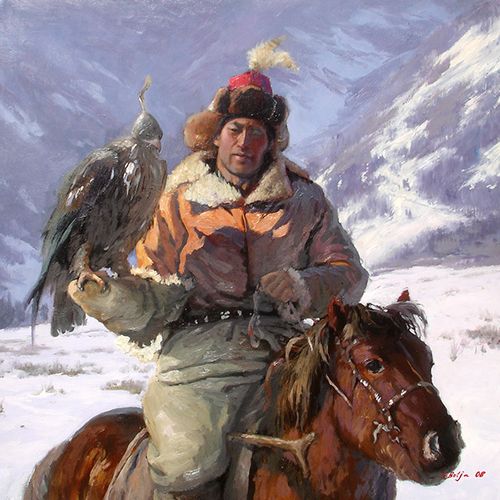
Composition and Subject “Eagle Hunter 4” centers on the profound, ancient bond between the Mongolian nomad and the golden eagle. Set within a perfectly square 64 x 64 cm frame, the composition is highly focused and intimate, drawing the viewer’s eye directly to the interplay between the human and the avian predator. The hunter is depicted in traditional nomadic winter attire—likely a heavy, fur-lined deel (coat) and a distinctive fox-fur loovuuz (hat)—protecting him from the biting cold of the Altai Mountains. On his thick, leather-clad arm rests a magnificent golden eagle.
Technique and Style True to Batjargal Tseintsogzol’s mastery of Photorealism and Realism, the painting operates as a stunningly accurate visual document. The oil on canvas technique is executed with microscopic precision. Tseintsogzol captures the intricate, varied textures of the scene: the coarse, wind-blown strands of the fox fur, the weathered, sun-baked creases on the hunter’s face, and the razor-sharp, layered plumage of the eagle. The lighting is remarkably lifelike, mirroring the crisp, unfiltered sunlight of the high-altitude Mongolian steppes. The interplay of light and shadow gives the eagle’s curved beak and the hunter’s resolute gaze a striking, three-dimensional depth.
Atmosphere and Mood Rooted deeply in the Nature style, the painting conveys a sense of stillness, reverence, and raw survival. There is no romanticized exaggeration; rather, the realism highlights the harsh, rugged reality of the hunter’s lifestyle. The background is likely a muted, out-of-focus expanse of the sweeping Mongolian landscape—perhaps snow-dusted crags or endless skies—which ensures the viewer’s absolute focus remains on the intense, quiet partnership in the foreground. It is a tribute to a fading heritage, frozen in a moment of quiet dignity.