

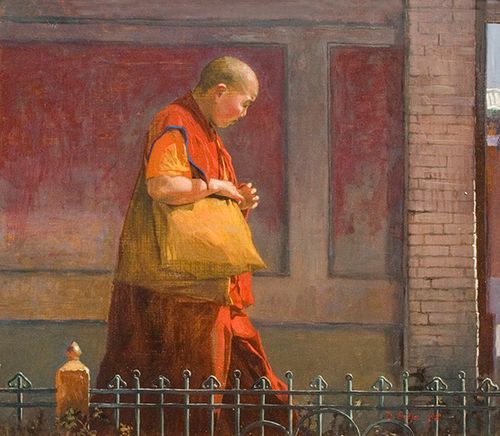
Batjargal Tseintsogzol’s Young Monk (2008) is a masterclass in contemporary photorealism, capturing a quiet, profound moment of Mongolian spiritual life. Despite its modest dimensions ($39 \times 44$cm), the work carries an immense emotional weight, characteristic of Tseintsogzol’s ability to find the extraordinary within the ordinary.
Visual Analysis
The painting depicts a young Buddhist monk, likely a novice, in a moment of stillness. Consistent with the Photorealist style, the artist’s brushwork is nearly invisible, favoring a level of detail that mimics the depth and clarity of a high-resolution photograph.
Texture and Light: Tseintsogzol excels in the rendering of textiles. The heavy, crimson and saffron folds of the monk’s robes are painted with tactile precision, showing the weight of the wool and the subtle wear of daily use.
The Subject: The focus is often on the monk’s face—rendered with a soft, naturalistic light that highlights the youthful elasticity of the skin against the disciplined, somber expression expected of his calling.
Composition: The tight framing creates an intimate, almost private atmosphere. By stripping away busy background elements, the artist forces the viewer to confront the human element of the monastic tradition—the intersection of childhood innocence and ancient religious duty.
Context and Style
Born in Ulaanbaatar, Tseintsogzol was a pivotal figure in Mongolian contemporary art, known for bridging the gap between traditional Mongolian subjects and global Realist techniques.
